

Hirata’s new building is a phenomenon in Tokyo – as a city where apartments are highly compact, the creation of a building that expands within its space and is surrounded by greenery, has opened up new doors of opportunity for the highly populated city. Although it is primarily a residential building, Tree-ness House also contains spaces for commercial tenants at its lower levels. Located on a deep but narrow site, the slender design employs an organic layering system to generate a series of three-dimensional spaces that relate to the building’s surroundings. 
Akihisa Hirata’s scheme consists of three primary elements: boxes, which form a layered volume that includes numerous voids; pleats, the openings in the boxes that create an ambiguous relationship between inside and out; and plants, the greenery that establishes three-dimensional gardens around the structure’s perimeter.
“The arrangement of functional volumes and voids, openings, and greenery integrates and entangles the building into a single organic whole,” says the design team. 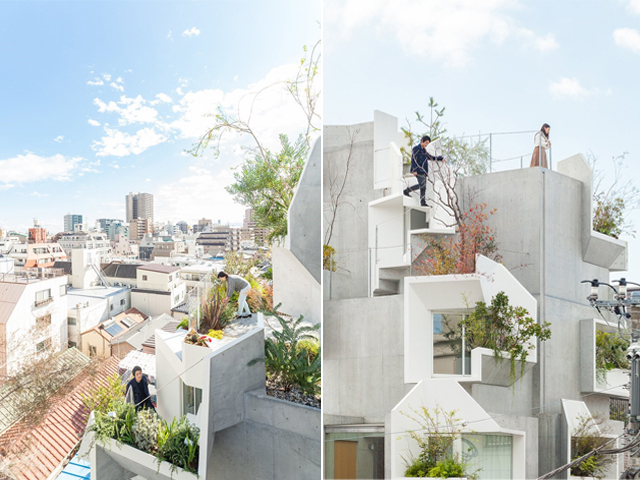
In contrast to typical buildings that simply stack floors one on top of the other, the design considers contextual elements, such as the street and other exterior spaces. This creates what the architect calls a “tangled” space that is characterised by ambiguous indoor-outdoor relationships.
“A tree consists of different parts such as roots, a trunk, branches, leaves and flowers, but these parts are not totally independent,” explains Hirata. “The trunk and leaves differ in appearance but are very similar in their basic structure — their inter-relationship creates a kind of nested or layered organic structure. 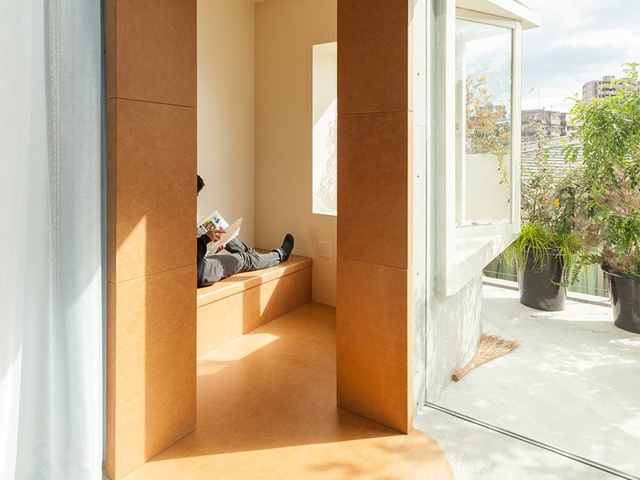
“It is possible to create an architectural logic that creates a similar organically layered and ‘tangled’ structure. The design seeks to develop this new architectural principle, with the intention of creating a complex ecosystem connected to the city.” 