
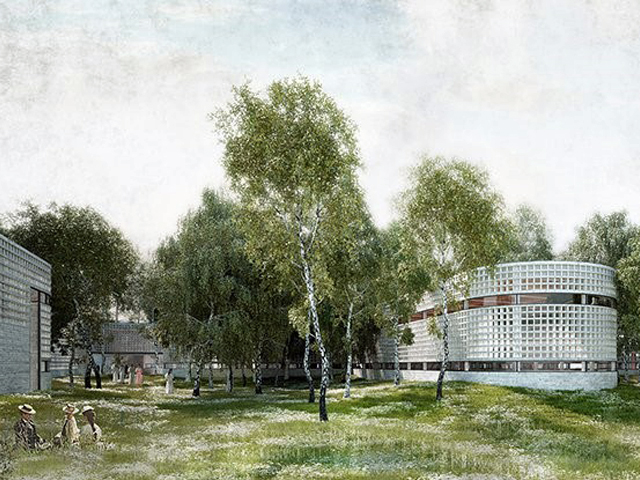
Leonidas Papalampropoulos and Georgia Syriopoulou adopt the typology of an enclosed garden, Hortus Conclusus, in their proposal for a new administration building in the city of Elefsina, Greece. The project reformulates the topology of the existing vegetation in order to define an internal landscape, which acts as a sanctuary for rest, meditation and memory, amid undefined boundaries, vague spaces and fragmented public spaces in the junction of the city with the industrial area. A new social space is offered to the citizens within the building for the reinforcement of local identity. 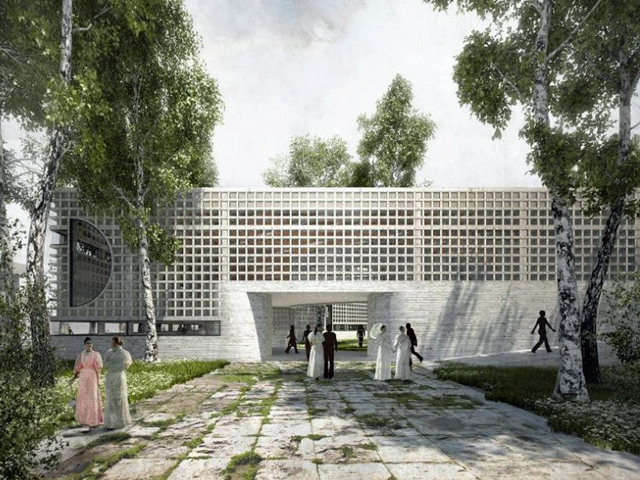
Acting as a spatial metaphor of paradise, the preservation of the site’s topography creates a symbolic connection with the mythological story of the surrounding landscape, where the famous myth tells the story of Hades, the god of the Underworld, and his kidnapping of Persephone, daughter of Demeter the goddess of fertility. 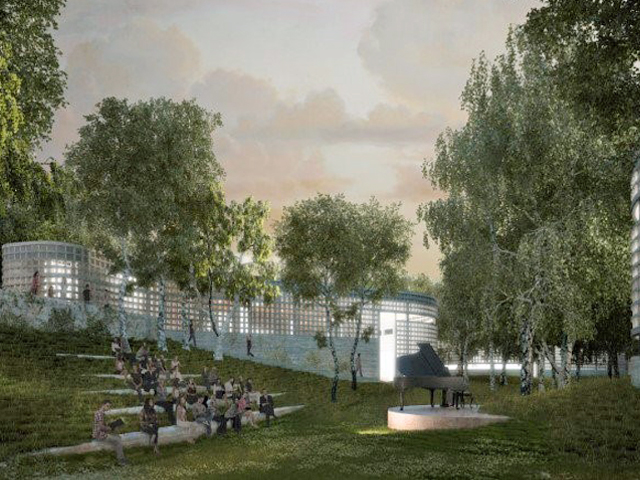
Papalampropoulos and Syriopoulou‘s proposal focuses on three main features: the preservation of the spatial qualities and inherent atmosphere of the place, the creation of a new ‘urban artefact’ with which to reassemble the dispersed public space of the city, and the expression of the historic memory of Elefsina through the gesture of enclosure. These features signify the symbolic transition into the space of ‘the other’, and the contrasting scales of various urban elements as an outcome of the coexisting fragments from the city’s past. 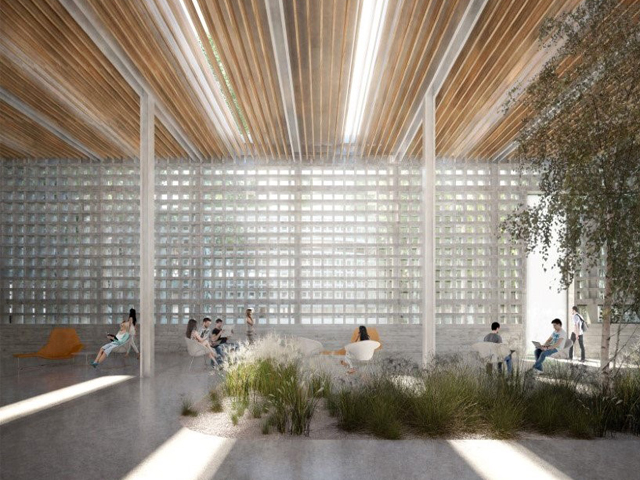
The gesture of enclosure in Hortus Conclusus shapes the building as a landmark within the urban scale with a robust visual identity. At the same time, the manipulation of the façade and the allocation of functions address the scale of the adjacent neighbourhood and the pedestrian experience, with façades that act as semi-transparent filters and allow views of the micro-scale inside the building. 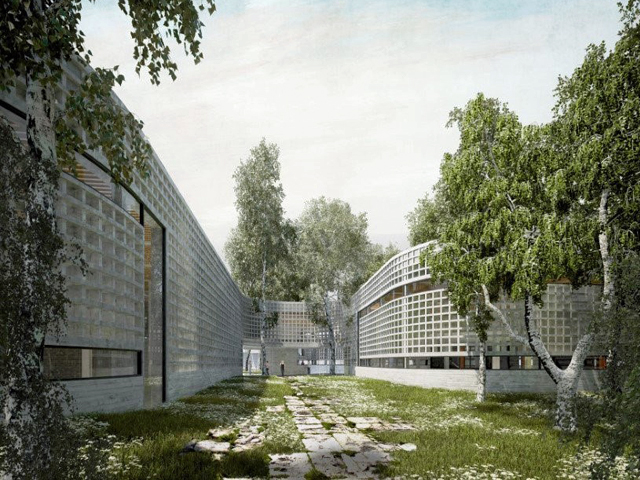
Two ramps on the external sides of the building allow for public access to the garden, which can function both independently and in conjunction with the office spaces, acting as a meeting space for visitors and employees alike. The main entrance to the administration building welcomes the visitor with a view of the surrounding greenspace, providing access to the office spaces, the public function spaces, which include an auditorium, exhibition spaces and a café, and the garden itself.