HASSELL'S VISION FOR NGURRA IN THE CAPITAL RECOGNISED ON THE INTERNATIONAL STAGE
16 Sep 2025
Hassell’s design for Ngurra: The National Aboriginal and Torres Strait Islander Cultural Precinct has recently been recognised on the global stage with a 2025 International Architecture Award.

Located in Canberra on Ngunnawal and Ngambri Country, Ngurra is a bold architectural statement and a profound cultural intervention, expressing the significance of First Nations’ history and traditions on Australia’s national conscience. Created in collaboration with Djinjama, COLA Studio and Edition Office, the award-winning project is set to become one of Australia’s most significant cultural institutions, a place where First Nations histories, knowledge and traditions are embedded in every aspect of the design.
"Djinjama guided us in an Indigenous-led design process that allowed us to sense Country, which means that deep time and memory has been captured into the design," Hassell Head of Design Mark Loughnan said. "It's a design where Country, kin, and community are embedded.
"First Nations voices were at the centre of the process from the beginning and Djinjama guided the design team through a methodology called Sensing Country, a practice of listening, observing and attuning to the messages of land, water and sky. Our proposal was for Elders and cultural Knowledge Holders to inform decisions about orientation, materials and ceremonial protocols and rather than treating Indigenous consultation as a 'stage' in the design process. The result was a precinct where First Nations knowledge was structurally embedded in how the place functions and feels. It created cultural safety for First Nations peoples who can see themselves reflected in the architecture, feel welcomed by its forms, and know their stories are carried in the fabric of the design."
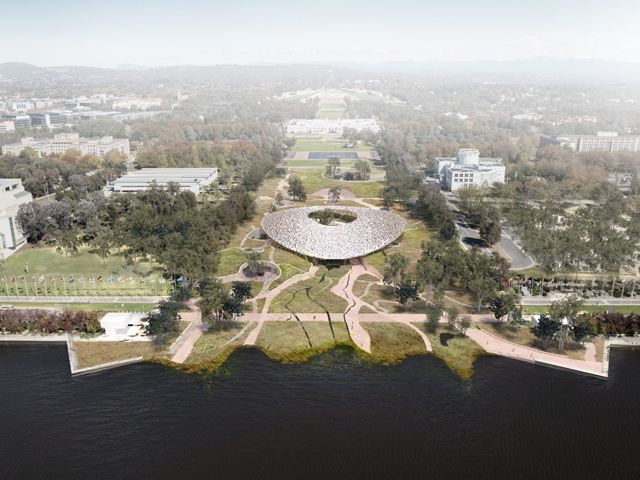
The precinct integrates flowing organic forms, natural materials such as rammed earth and timber, and strong symbolic gestures that speak to kinship and ceremony. The organisation, flow and movement of people throughout the design has been drawn from observation and meditation on the movement of animals through the landscape, a movement that has occurred for millennia.
More than a landmark, Ngurra aspires to be a place of healing, truth-telling and reconciliation, rebalancing Australia’s civic landscape. These choices were also designed to shape how people feel, reminding visitors that Ngurra was not meant to be an imposed monument, but a place born of the land, shaped by its materials and reflective of its stories.
“We asked that our Ancestors guide our hands and minds in the design, and we believe they have done so. Country has led our design team, and this is the legacy of our project,” said Daniele Hromek, the project’s First Nations designer and cultural advisor.
Ngurra, a word for ‘home’, ‘camp’ and ‘a place of belonging’ in many different Aboriginal languages, has been designed to house two distinct spaces: The National Indigenous Knowledge and Cultural Centre, and the National Resting Place.
NATURAL INDIGENOUS KNOWLEDGE AND CULTURAL CENTRE
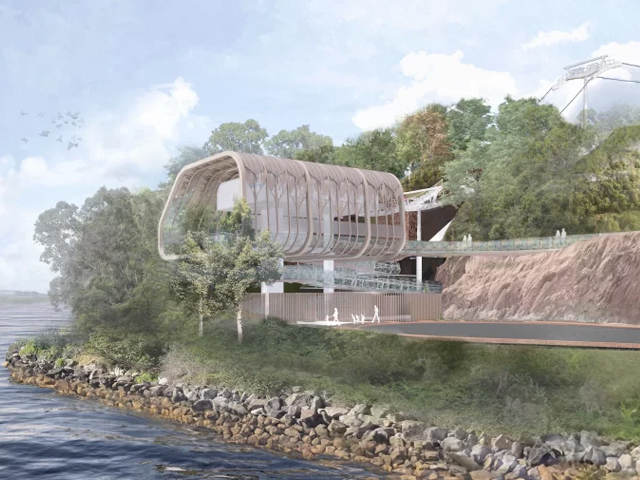
Welcoming all visitors, the design concept for the National Indigenous Knowledge and Cultural Centre incorporates a large, organic and embracing canopy, gently held aloft over a central plaza, framing and bowing towards Bulajima, Mount Ainslie, marking the presence and arrival to the precinct.
The largest of the spaces, it will function as a central plaza hosting a new community room for events and functions. Beside the courtyard, the indoor cultural centre will be nestled into the hilly landscape – with visualisations depicting the structure wrapped by textured walls and glass openings, and topped with greenery.
NATIONAL RESTING PLACE
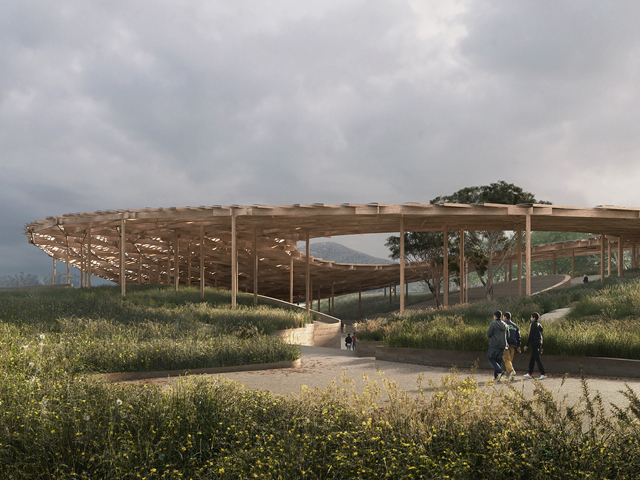
The National Resting Place is designed as a private ceremonial building, an indentation into the rolling ground that forms a soft counterweight to the floating form of the Cultural Centre’s canopy. The Repatriation Space lies in the centre of this form, in direct relationship to a secluded and sacred inner courtyard, allowing a highly protected place for ceremony, for song, sorrow and love.
Connecting each of the spaces will be a network of interweaving and meandering paths carved through the site's landscape. These were determined through an observation of the historical movement of animals across the landscape. Also included in the design is an amphitheatre, along with wildflower and grassland gardens.
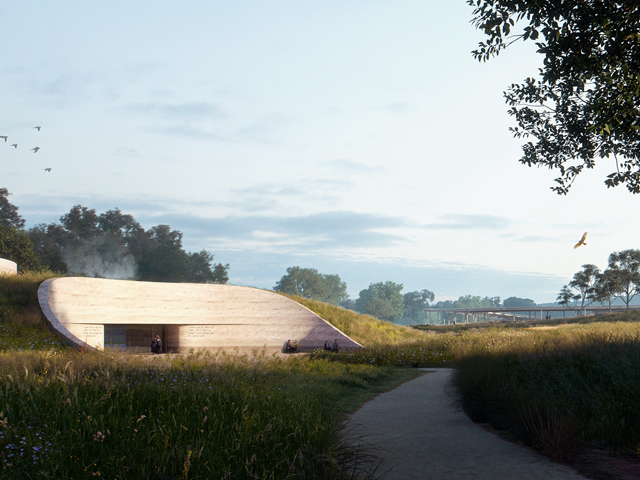
Envisioned as a new national landmark, international recognition helps acknowledge the importance of creating a globally recognisable home for the National Indigenous Knowledge and Cultural Centre and The National Resting Place, where architecture is an instrument for healing and a place of memory and meaning.
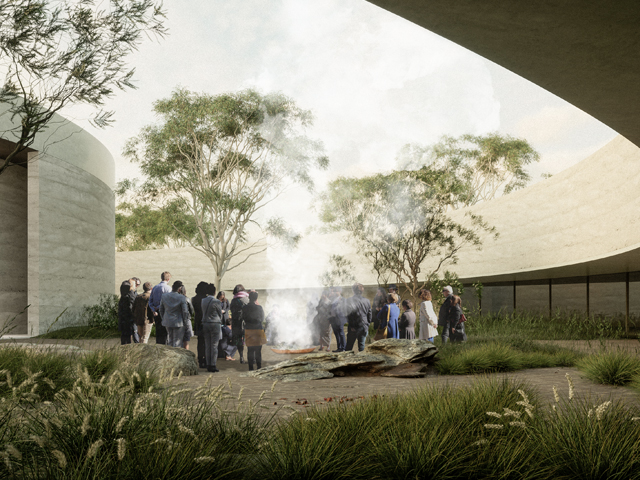
Loughnan explained, "Its lessons extend beyond design: it challenged other nations to consider whose voices shape the symbols they build and whose stories their cities tell, and we very much hope our design concept and proposition contributes to the ongoing dialogue and development of the cultural precinct."