SUSTAINABLE URBAN SPACE BLOOMS
10 Apr 2018
Urban Bloom, a new park in Shanghai, proves that urbanism can be both sustainable and enjoyable by blending man-made materials with natural elements to transform a parking lot into an exciting public space.
More and more, urban life is a negotiation between where we need to be, and where we want to be. What we have, and how much we don’t need. As life increasingly moves toward crowded cities, AIM Architecture and URBAN MATTERS were interested in creating a space that caters to enjoyment of that space, on its own merit and terms.
Urban Bloom is an experiment in urban space and activities taking precedent over a design’s intention or infrastructure’s needs. The only need here was for freedom, and the intention is joy. Urban Bloom renews, and invigorates, urbanism – in fact, the original location was a parking lot. Transformed into an ideal urban garden, and constructed entirely from artificial means, it is a project for a city that emphasizes people. 
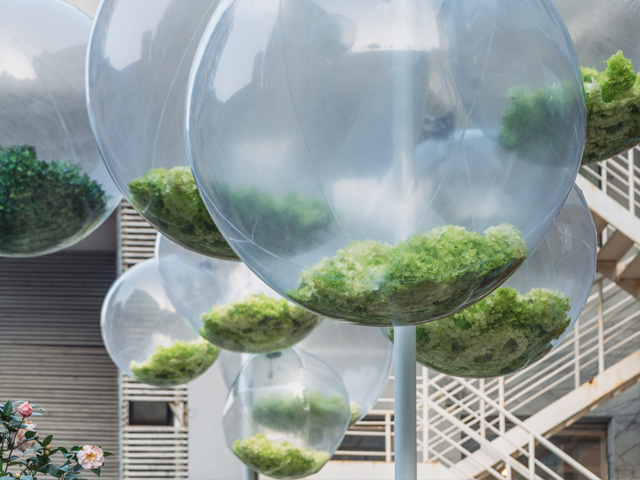
Balloon-like shapes hold colourful foliage, and float above the courtyard like tree leaves, flooding the space with shadows and shapes. Rich varieties of flowers and vegetation were placed among the modules, and as they bloom and grow, the platform will be transformed into an open, welcoming garden.
Anfu Road, Shanghai, was the perfect place to introduce this concept, as it is a popular street that mixes residential buildings with offices, restaurants, shops, and schools. Thirty slab towers sit neatly next to 3-storey lane houses. This mix of scale is quite unique in Shanghai. Anfu Road already proved you don’t need to flatten the old city to create new life or to generate prosperity in an ever evolving city. But what it lacked was a park. So why not create a place that cultivates this pleasure and happiness? 
Visitors are encouraged to explore the space and interpret its purpose through their own experiences and needs. In the same way that certain city blocks flow with rivers of people, or flowers grow toward the light, the behaviour pattern of each visitor, and the energy of the environment, will intangibly define the space and its character.
At the same time, cities are huge producers of waste. Urban Bloom was engineered to be low impact and interact with natural elements in an artificial way – in short, proving it’s possible to make something new from nothing new at all. So much about urbanism is not sustainable – the pace of life, waste, cost. Designed specifically with the concerns of waste and consumption in mind, and every city dweller’s desire for more nature, Urban Bloom is entirely sustainable and relies on repurposed and recycled materials. Recycled wooden pallets are refabricated as a gently undulating landscape where different kinds of common urban scenarios are possible: casual gatherings, mini-lectures, or outdoor theatre seating. 
Like many things in this city before it, Urban Bloom is an impermanent fixture in the landscape of the city, but serves to remind inhabitants of the importance of enjoying urban space. It is the physical manifestation of our vision for a new kind of urbanity, one that is both man-made and natural, permanent and flexible, rational and intuitive.