
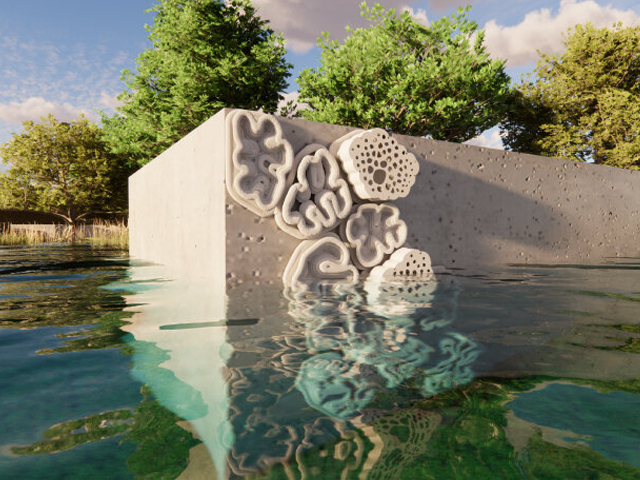
Text description provided. Architects and marine biologists at Florida International University have developed BIOCAP tiles, a series of 3D printed coral reefs that combat climate change by creating cooler microenvironments.
Designed to support marine life, these modular tiles reduce the impact of waves along the seawalls. They’re designed to help water cities like Miami adapt to the rising sea levels, all the while restoring the ecological balance along the shorelines.
The researchers, led by Sara Pezeshk and Shahin Vassigh, enumerate some ways that the 3D printed coral reef seawalls can help fight climate change. Each BIOCAP tile, for example, has shaded grooves, crevices, and small, water-holding pockets. Because of these, they mimic the natural shoreline conditions. They also construct tiny homes for barnacles, oysters, sponges, and other marine organisms that filter and improve water quality. Design-wise, the BIOCAP tiles have swirling surface patterns that increase their overall surface area. On top of that, they give the marine life more space for colonisation.
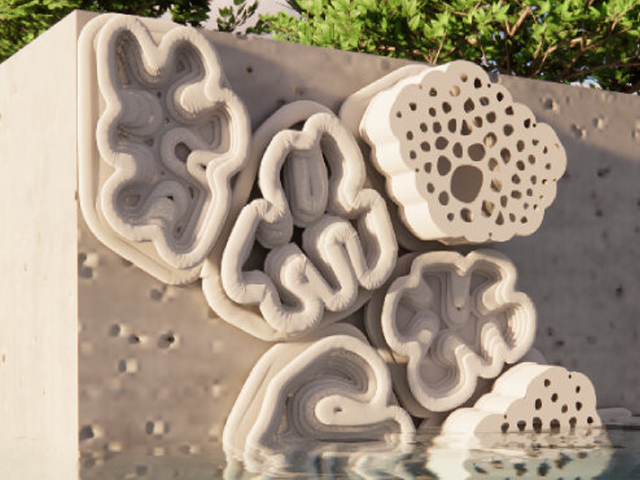
There are shaded recesses around the 3D printed coral reefs, which regulate the temperature to provide cooler and more stable microenvironments for the nearby marine life. This thermal buffering supports the species when the rising water’s temperatures change as well as during the frequent heat events driven by climate change. Postdoctoral fellow Sara Pezeshk says that the bouncing back of the waves can increase erosion at the base of the seawalls, which can result in hazardous conditions during storms.
With the textured surfaces of the BIOCAP tiles, they diffuse this wave energy by replicating the natural, untouched shorelines like rocky coasts or mangroves and slowly break up wave energy. The tile shapes also come from how water interacts with different high-tide and low-tide surfaces. Along these 3D printed coral-reef-inspired designs, there are concave surfaces that deflect the waves away and reduce their direct impact on the seawalls.
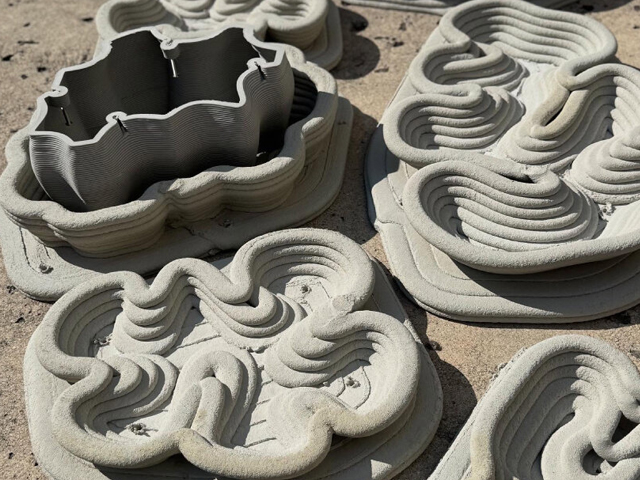
At the present time, the BIOCAP project has entered a two-year pilot phase. The research team needs to see and check how efficient and effective these seawall tiles are. Part of the trial is to also measure how the tiles influence biodiversity, water quality and wave energy reduction. They use underwater cameras to collect time-lapse images of marine organisms that settle on the tile surfaces. They allow for tracking species presence and habitat use over time. The prototype 3D printed coral reefs have embedded sensors in them.
These devices monitor the water quality as well as measure the pH levels, dissolved oxygen, salinity, turbidity, and temperature in real time. The researchers analyze the water attenuation by comparing pressure sensor data collected from both the BIOCAP tiles and adjacent sections of traditional seawall. The pilot BIOCAP tiles are installed on the existing seawall in Morningside Park, Miami, in the spring of 2025. The project has also received funding from the National Science Foundation and the Environmental Protection Agency.
The pilot project begun in Miami earlier this year.