
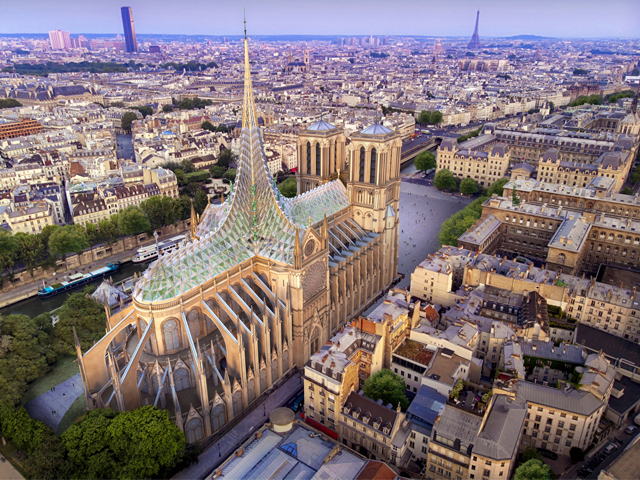
Vincent Callebaut Architectures has unveiled images of their tribute to Notre-Dame Cathedral following the fire that badly damaged the historic structure. A transcendent project that forms a symbol of a resilient and ecological future, the project is inspired by biomimicry and a common ethic for a fairer symbiotic relationship between humans and nature.
The Palingenesis project, derived from the Greek word for “rebirth” and “regeneration,” aims to blend in naturally as a single stroke between the roof and spire. From the four gables, the original geometry of the 10-metre-high attic has been respected, with 55-degree pitched roofs gradually stretching to shape a vertical spire. Respecting the inherent principles of the building’s structural loads towards the flying buttresses and inner fasciculated pillars, the four roofing lines and four lines of the roof’s ribs bend and join together in harmony towards the sky, producing a parametric and light geometry.
Constructed of cross-laminated timber beams, the scheme’s oak frame seeks to use the minimum amount of material to ensure a low carbon footprint while offering transparency to the cathedral. Atop the spire, the rooster located and found in the rubble will crown the scheme, remaining a “spiritual lightning rod” and “protector of the faithful”. 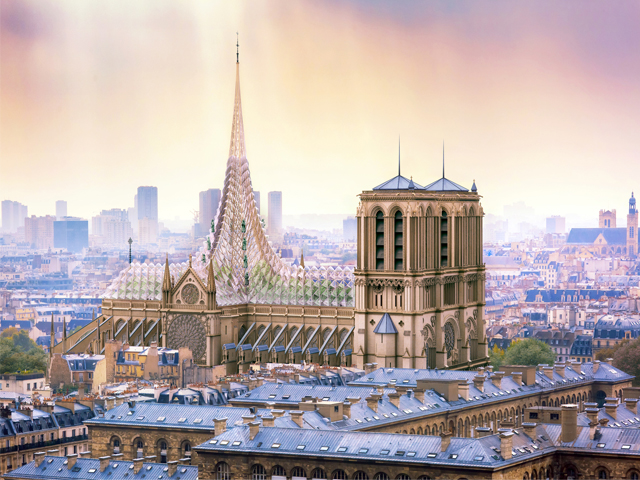
“The new architecture of the spire, like a shroud raised from the keystone of the transept crossing, evokes the rebirth but also the mystery of the cathedral and the resurrection of Christ. And under the shroud, life and renewal emerge,” says Vincent Callebaut Architectures. “Notre-Dame dazzles the world again while amplifying her universal message of peace and her spiritual aspiration.”
Central to Callebaut’s scheme is the idea of turning Notre-Dame into a positive energy building, producing more energy than it consumes. Through energetic solidarity with the body of the historic monument, the contemporary, three-dimensional Gothic stained-glass graft produces the scheme’s energy, heat, and passive ventilation.
The wooden frame is covered in three-dimensional crystal glass subdivided into faceted diamond-shaped elements. Consisting of an organic active layer, this cocktail of carbon, hydrogen, nitrogen, and oxygen will absorb light and transform it into power. The energy, stored within hydrogen fuel cells, will be directly redistributed throughout the cathedral. 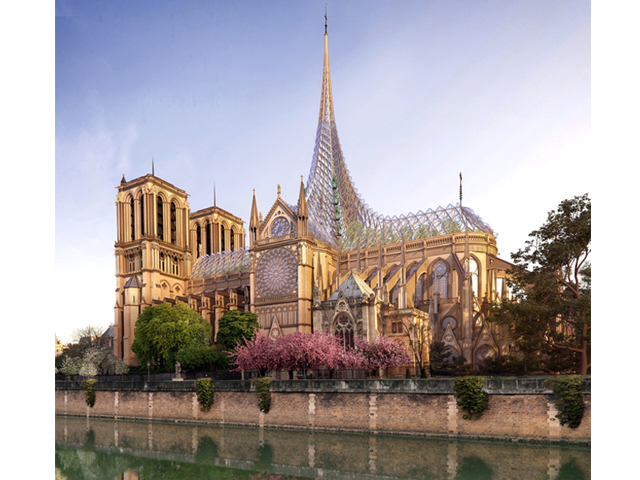
The roof-spire in the cathedral attic also provides a thermal buffer space, which accumulates hot air in winter to better isolate the cathedral, and vents with fresh air in the summer through the evapotranspiration of plants. Thus, the cathedral would become an exemplary eco-engineering structure and the Church a true pioneer in environmental resiliency.
At its heart, the project features a garden devoted to contemplation and meditation. Going beyond aesthetics, the garden is to be cultivated by volunteers and charitable associations. Aquaponics and permaculture produce up to 25kg of fruit and vegetables per square metre per year. Therefore, up to 21 tons of fruits and vegetables could be harvested and directly redistributed for free each year. To that end, a farmers' market would be held every week on the forecourt of Notre-Dame.
This urban farm is arranged atop the Latin-cross plan of the roof and set in planters, which essentially redraw the layout of six-part vaults on the ground. This geometric garden "à la française" relies on a double-deck structure with light soil to grow its fruits and vegetables along the nave, from East to West, from the two towers to the apse. In the North-South axis, the roofs of the transept host aquaponic basins feeding plants with natural, fish fertilisers. Moreover, these water mirrors expand the place by reflecting the rose windows on the North and South side gables. 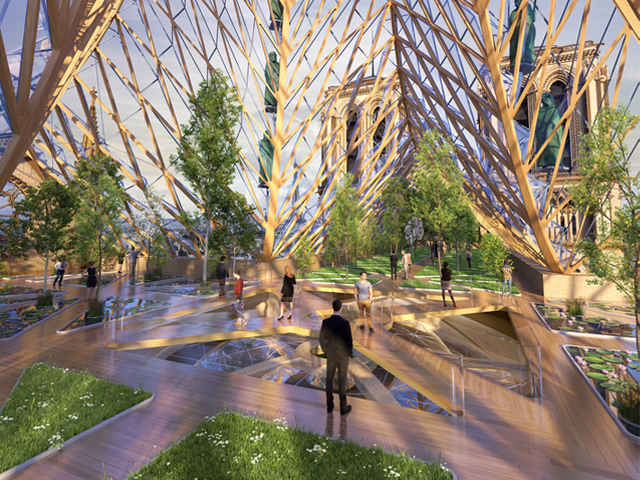
Via ArchDaily | Images © Vincent Callebaut Architectures