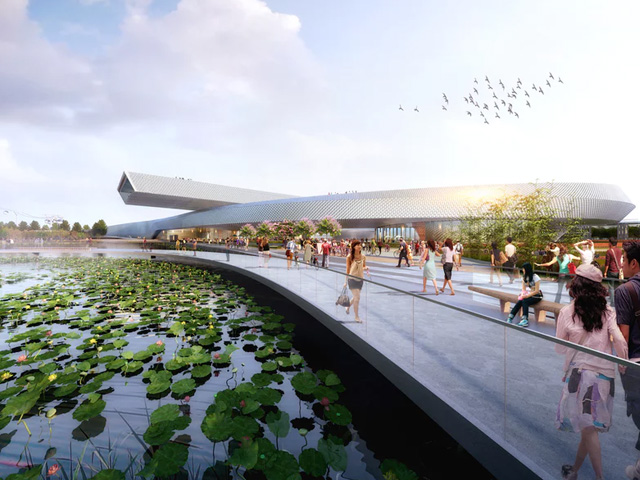

On the back of its success with the Shanghai Natural History Museum, architectural firm Perkins+Will has unveiled plans to return to China with its similarly ambitious Suzhou Science & Technology Museum. The project features an interesting looping form and some sustainable design, including a green roof and rainwater management.
Intended to serve as the centrepiece of a new cultural district northwest of Shanghai, the Suzhou Science & Technology Museum is shaped like a ribbon and looks similar to BIG's Villa Gug, albeit on a larger scale. According to the firm, it's also meant to bring to mind a silk scarf - a popular export in the area.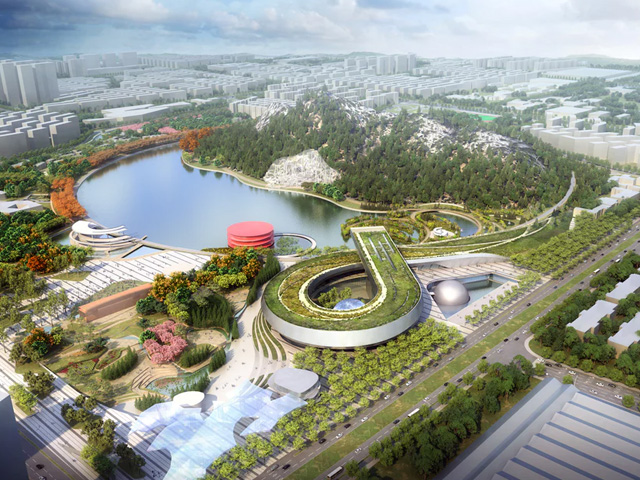
The 55,741sqm building will emerge from the base of a nearby mountain and cantilever over a lake and an archipelago of small artificial islands. It will sport a metal mesh facade that transitions from opaque to transparent, offering control of daylight and solar gain for light-sensitive exhibits. This will also allow interior light to filter through the facade at night, making the museum glow like a lantern.
Visitors will enter the museum through a three-story atrium adjacent to a sunken water-filled courtyard. The renders depict a large globe at the building's centre and there will also be an industrial exhibition hall highlighting the role of industrial development in improving people's lives.
Perkins+Will has revealed some green design planned for the Suzhou Science & Technology Museum. It will focus on providing natural daylight and a forest will be planted in an attempt to offer a buffer from the city pollution and provide a more pleasant setting.
Public walkways will serve as outdoor learning environments, with signage guiding children and adults to learn about water purification and stormwater management. Permeable paving and landscaping will be used to manage rainwater, while the museum will be topped by a huge green roof (installed, says Perkins+Will, to mitigate heat island effect). In addition, a series of water filtering gardens will aim to improve the quality of the lake's water.
The project has not yet been given the green light to proceed, but the design is certainly a promising start.