
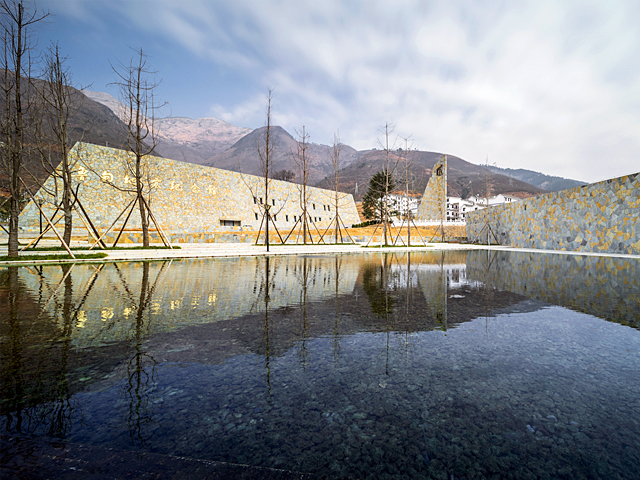
The earthquake occurred in Longtoushan Town on August 3, 2014, at a 6.5-magnitude, resulting in 617 deaths, 112 missing and 3143 injured. The design retains the original Town Hall as part of the earthquake site park and has become the memory of Longtoushan Town for the people.
CONCEPT
The site was barren in the aftermath of the earthquake, with only a single eucalyptus tree surviving, symbolising unyielding life. The design of the new space took the tree as the starting point, the centre of the circle, and drew an hour hand toward the air at 16:30, marking the time of the earthquake. The “great crack” formed on the ground marks the effect of the earthquake. At the end of the crack is a towering monument that overlooks every corner of the site. 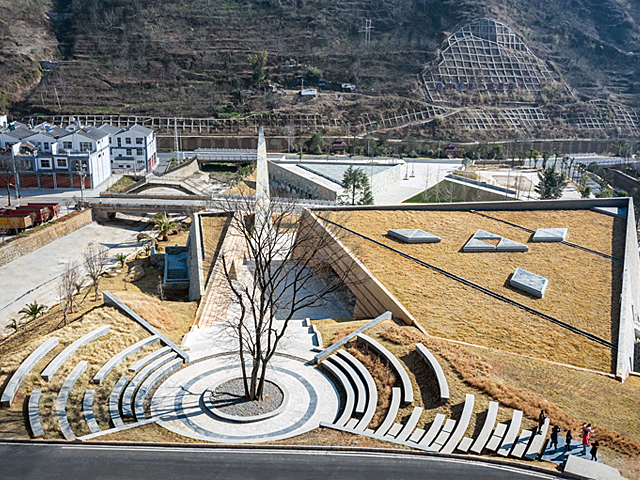
SPATIAL SEQUENCE
The overall planning layout includes parks, tourist service centres, memorial halls and earthquake sites, forming a spatial sequence of four themes: tranquillity, rupture, rebirth, and recollection. People pass through the tranquil water surface, the fissures of the earth and the unrelenting life represented by the trees. When they reach the earthquake site, their emotions are encouraged to grow. 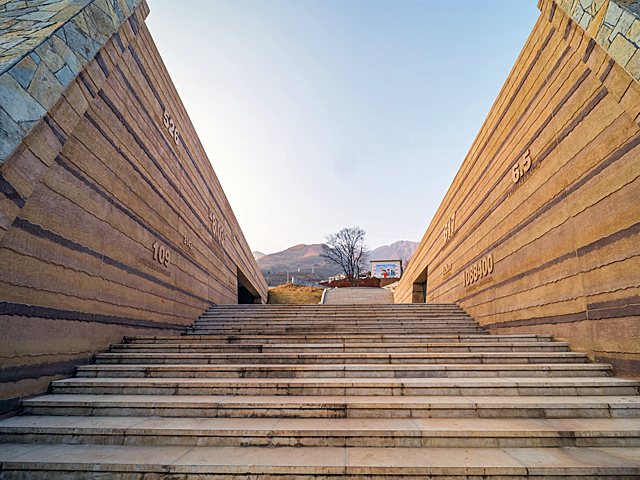
FORM
The layout of the triangle reflects the fissure of the earth, the groundbreaking form reflects the tremendous destructive power of the earthquake. The exterior wall material is naturally built with local stone, and the roof greening is combined with the site to create a sense of shock without appearing abrupt.
The memorial is not just a serious place for reflection, but a part of the daily lives of the community. 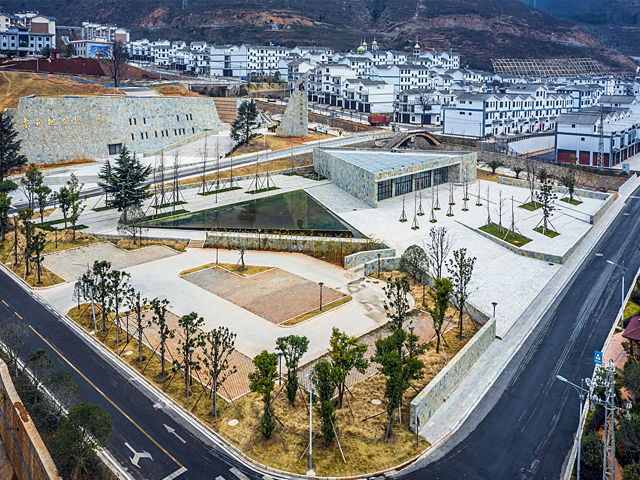
STRUCTURE AND INTERIOR SPACE
The design highlights structural aesthetics and creates a spiritual space. The structure conforms to the architectural form, using triangular beams and hexagonal columns. Part of the interior design does not have a ceiling, introducing skylight into the space, which fully embodies the structural aesthetics and considers the creation of indoor space by natural light. 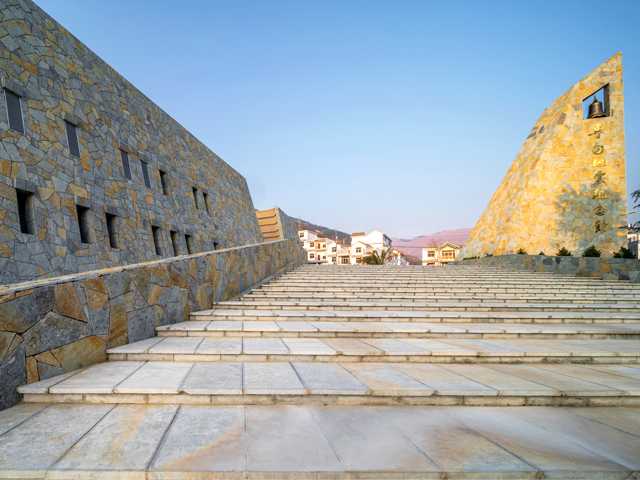
Via ArchDaily | Image © Xiu Huo