
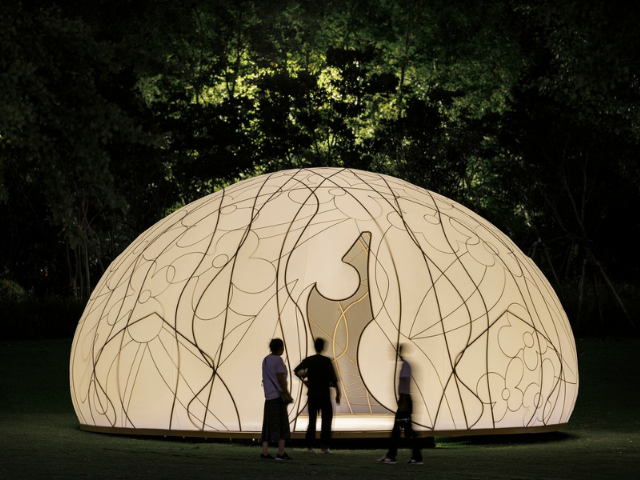
Text description provided by the architects. Osmanthus Moon is a short-term public art installation created to celebrate the traditional Chinese Mid-Autumn Festival. It is a projection, specially as well as metaphorically, of the widely beloved traditional osmanthus pattern — a signature plant and flavor of autumn — and forms a dialogue with the action paintings of a folk "Zao Hua" (stove flower) artist, an intangible cultural heritage tradition.
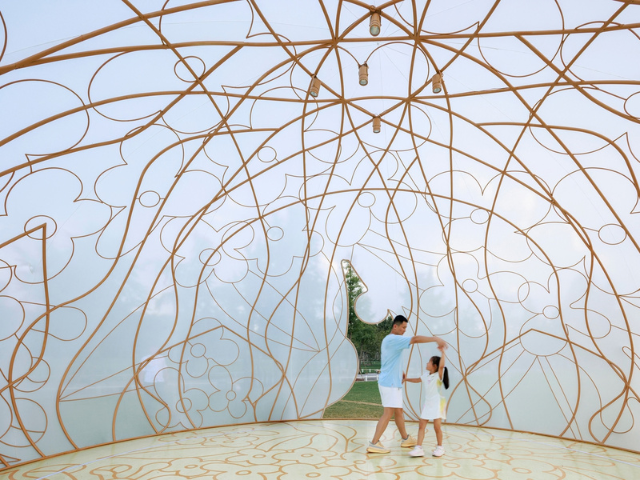
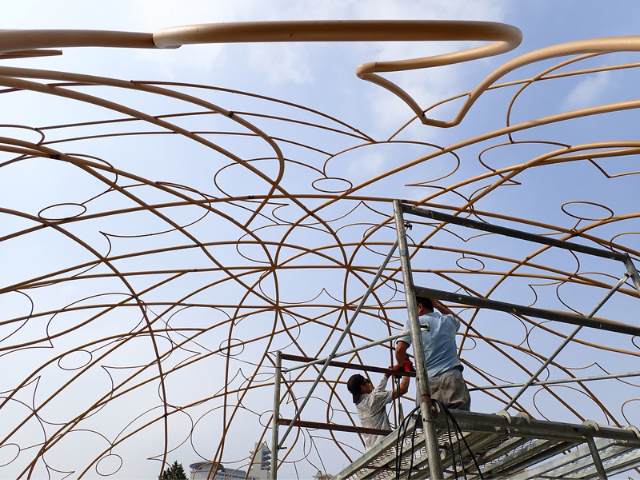
The pavilion rests on the semicircular lawn of Century Park like a translucent full moon descending in quietness. Its spatial framework weaves traditional osmanthus motifs into vine-like bronze patterns, while lightweight elastic fabric stretches across the surface to form the moon's luminous skin. The design pays tribute to the 'golden cabbage' of the Vienna Secession while aspiring to evoke the romantic sci-fi sensibility of Buckminster Fuller domes.
The osmanthus patterns painted on the ground by the Zao Hua artist mirror the golden lattice of the dome above — each a projection of the other. Together, they form a complementary dialogue between on-site and prefabrication, movement and stillness. Delicate, radiant, and fragile — it embodies the timeless yet brittle joy and longing that the 'moon' and the 'osmanthus' have evoked through the ages.
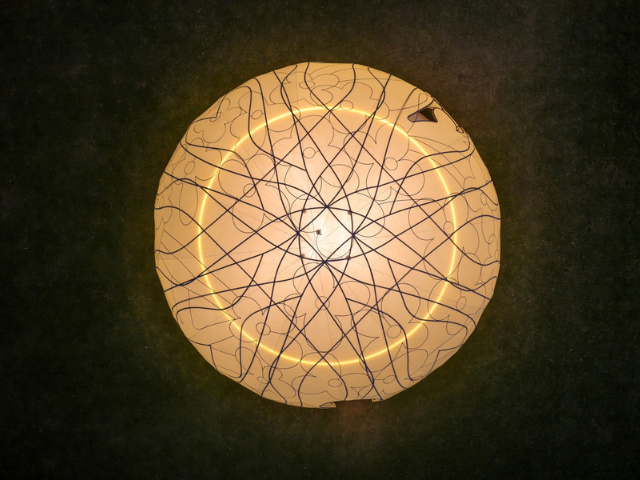
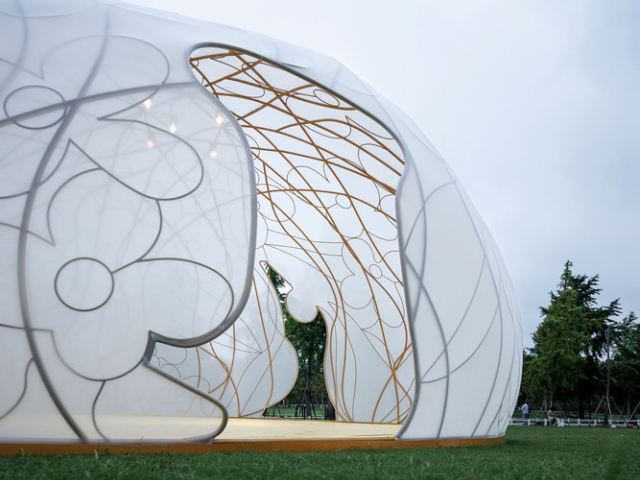
Visitors may enter through two irregular openings into the interior of the moon. During the daytime, the space is characterized by impressionistic light and soft textile surfaces; at night, the interplay of shadows and diffused illumination transforms the interior into an immersive, dreamlike environment — as if one were stepping into a temporal mirror.
OSMANTHUS MOON
LOCATION Shanghai, China
ARCHITECT HCCH Studio
PHOTOGRAPHY Guowei Liu