
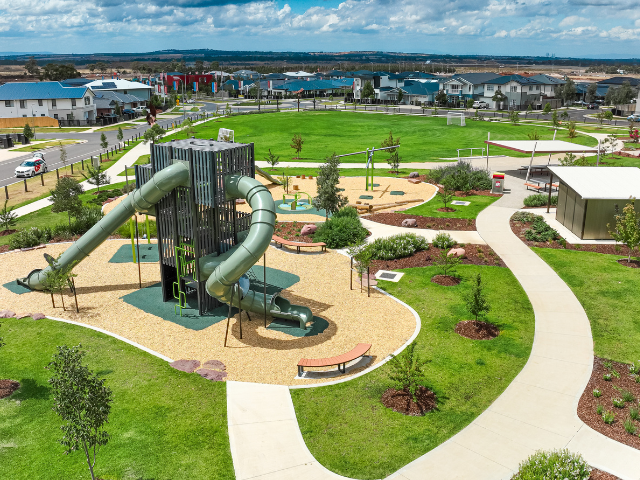
Image Redstone Park, Fleming's Group
The key driver is essentially consumer demand, and a keen observation of demography from town planning professionals. As we move to more high-density living, life itself is lived in public parks. Population is expected to reach 33-Million by 2040 so local councils are working to create more multi-functional, climate-resilient urban parks. Use of national parks and urban greenspaces has grown significantly since the COVID-19 pandemic.
At the National end of the scale there has never been more demand for National Park facilities. Research shows 72% of Australians support establishing new national parks to protect natural and cultural values.
In the state of NSW, there are several significant developments. Under the NSW Parks for People Program - a joint NSW and Commonwealth $300 million investment – there are currently a number of new open spaces and urban parks across transport-oriented development precincts in development such as Leppington Park and Toggerai Park in Bankstown. The NSW Government is also advancing plans to formally reserve the Great Koala National Park backed by $140 million in total funding. State governments continue to pump millions into park infrastructure (e.g., a $130 million injection into NSW National Parks for walking tracks, campgrounds, and accessibility).
Urban neighbourhood parks across Australia are also undergoing a wave of development and revitalisation. As Australian capital cities continue to densify, state governments and local councils are shifting away from sprawling suburban yards and investing heavily in "pocket parks," precinct-level urban greening, and multi-functional community hubs.
The current landscape of urban park development across the country features major initiatives and strategic shifts. The NSW Government rolled out the $40 million “Better Open Spaces Program”. This initiative directly addresses high-growth housing corridors by matching funding for local councils to upgrade urban playspaces, fitness zones, and picnic areas. Simultaneously, the “Greening Our City Program” has expanded outside Sydney into fast-growing regional city centres like the Central Coast, pumping millions into massive tree-canopy and biodiverse understorey planting projects.
In Victoria, the State Government launched a $30 million community-voted program called “Pick my Park”. Having already delivered nearly $18 million across nearly 100 pocket parks, playgrounds, and urban gathering spaces, the program expanded across all of metropolitan Melbourne, Geelong, Bendigo, and Ballarat to fast-track resident-led green space infrastructure.
The Federal Government's latest funding rounds target precinct infrastructure, including the $2.25 million Acton Waterfront Neighbourhood Precinct in Canberra, the Redfern Place Infrastructure Project ($20 million) in Sydney, and Melbourne's Sandridge Recreation Precinct Masterplan.
THE NEW DESIGN TRENDS FOR NEIGHBOURHOOD PARKS
Urban park design has fundamentally pivoted to address the realities of modern, dense apartment living:
- Adoption of the '3-30-300' Rule: Urban planners and landscape architects are officially benchmarking park access around the 3-30-300 rule ensuring every resident can see 3 trees from their home, has 30% canopy cover in their neighbourhood, and lives no further than 300 metres away from a high-quality green space.
- Combating Urban Heat Islands: Because modern developments feature more paved surfaces and fewer private backyards, new parks are engineered with deep soil zones, native plants, and heavy tree placement to serve as natural "evaporative coolers" for dense apartment blocks.
- Hyper-Local Active Spaces: Modern urban "pocket parks" are integrating all-abilities playgrounds, small skate blocks, and work-friendly amenities. A perfect example of this style of contemporary dense urban planning can be seen in communities like Lachlans Line Park and Elouera Reserve, which squeeze native plant landscaping, skate parks, barbecue spots, and play infrastructure directly alongside massive multi-use residential towers.
Janice Williams, Publisher at Outdoor Design Source
LINKS TO RECENT PUBLIC PARK INVESTMENT PROGRAMS
Great Koala National Park (NSW) https://www.nsw.gov.au/ministerial-releases/landmark-legislation-introduced-to-create-great-koala-national-park-for-conservation-culture-and-recreation
Better Urban Spaces Program (NSW) https://www.planning.nsw.gov.au/the-planning-system/open-space/better-open-spaces-program
Greening our City Program (NSW) https://www.insidestategovernment.com.au/nsw-city-greening-program-on-the-move-north/
Pick My Park (VIC) https://www.premier.vic.gov.au/pick-park-and-help-connect-your-community