
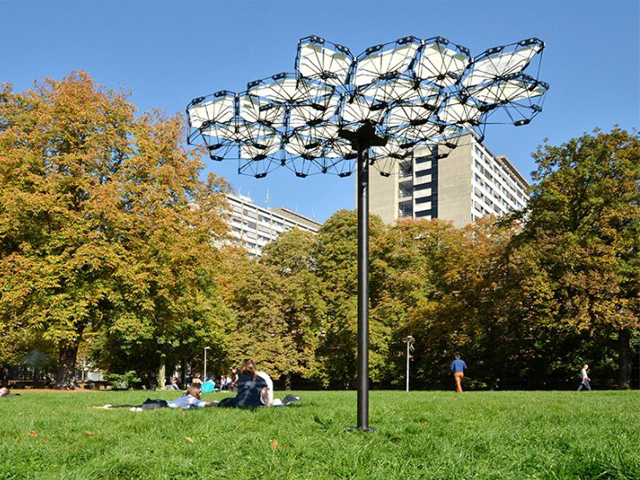
Project Cyber Physical Macro Materials was developed at the University of Stuttgart's Institute for Computational Design and Construction (ICD) to demonstrate a tangible vision of new, dynamic and intelligent architecture for public spaces. The agile and reconfigurable canopy is enabled by a combination of distributed robotic construction and programmable matter. Using drones, the canopy was created with modular components that could respond in real-time to the climate or the sun. 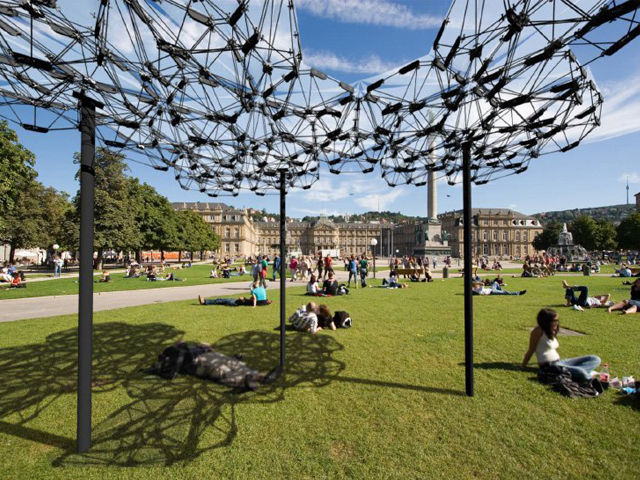
Created as an ITECH M.Sc. thesis project by students Miguel Aflalo, Behrooz Tahanzadeh and Jingcheng Chen, Cyber Physical Macro Materials builds upon previous building prototypes at the ICD/ITKE such as the Elytra Pavilion, ICD/ITKE Research Pavilion 2016-17 and Wall Climbing Robots, while opening entirely new trajectories for intelligent and reconfigurable architecture. The cyber physical material structure is comprised of a smart digital material built from lightweight carbon fibre filament with integrated electronics for communication and sensing, which operate alongside a collection of autonomous aerial vehicles, or ‘builders’. 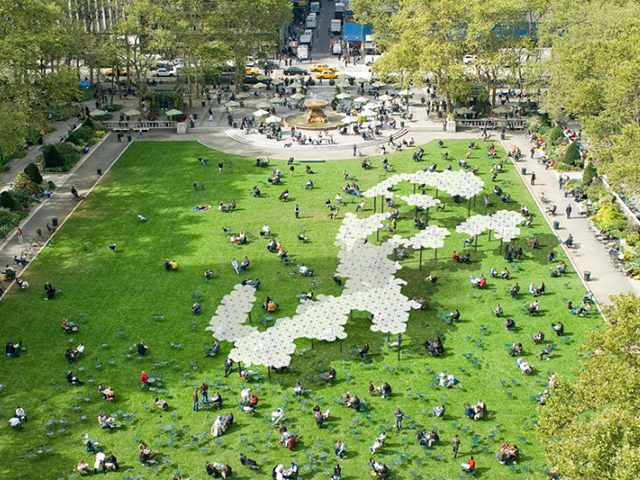
With its ability to continuously reconstruct during use, the system challenges pre-conceived ideas of robotic digital fabrication and sophisticated pre-fabrication for architecture. One can imagine an agile versatile canopy autonomously moving through a large public space according to the position of the sun, providing the occupants with shade or actively rebuilding itself to influence the occupants while at times retreating entirely to nearby rooftops. 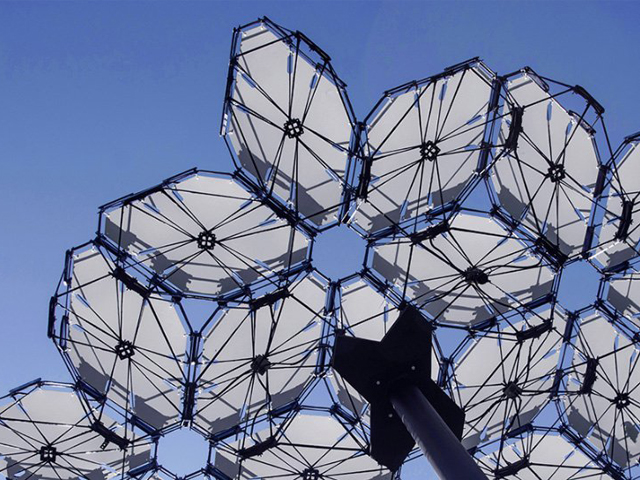
With this physical flexibility and distributed intelligence, new artificial attitudes and behavioural patterns arise, which are capable of swiftly activating public spaces in defiance of traditionally lethargic building processes and regulations.
See this amazing canopy in action!