

Spanning 283 meters in length, the Onda Atlántica footbridge sits at an isthmus in Las Palmas, Spain, where tides used to cross over not long ago. Urban development had progressively distanced these tides to create the Las Canteras beach and port area. The city today aims to reconnect these two zones through recreational and leisure activities along the waterfront. The new Onda Atlántica footbridge is one of the many new and ambitious plans to make that vision a reality.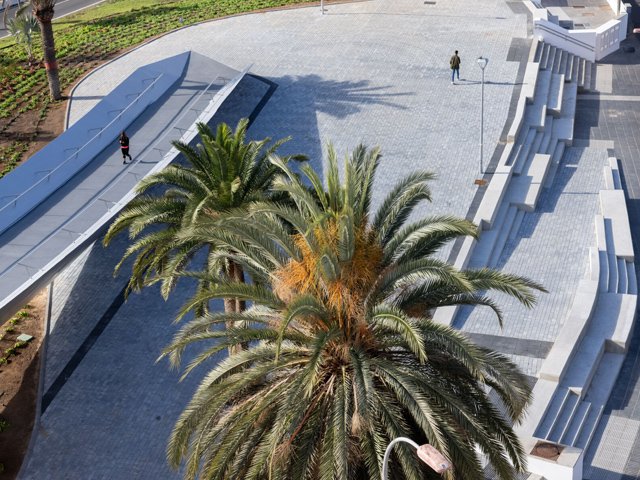
Local firms Onda Arquitectura and Checa Arquitectura were commissioned to design and build the bridge as a unique structural system that is both sturdy and light in appearance. Images of the structure reveal its sculptural nature, with its distinct V-shaped profile that penetrates two plazas at its landings, giving the illusion of continuation beneath them.
A sturdy urban sculpture that warps and curves effortlessly, the footbridge stretches over public spaces without any apparent tectonic effort. It showcases three dramatic, 63-meter spans without any intermediate supports, denoting an unexpected sense of lightness. Additionally, its undulating shape, which originally results from site constraints, dodges the existing trees while improving structural performance, allowing for a design that requires no expansion joints.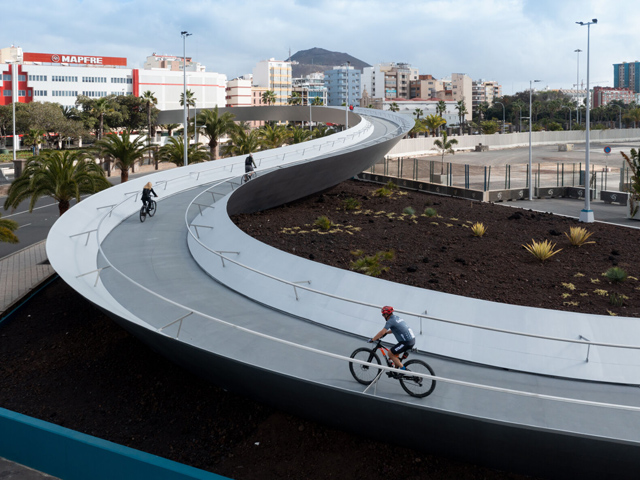
“The programmatic requirements for pedestrian, cyclists and accessible crossing are resolved with a unique and simple infrastructure, avoiding any differentiated elements such as stairs and auxiliary elevators,” explained the architectural team.
The V-shaped profile came from a need to mitigate the acoustic impact from the highway that runs beneath. It offers charming views to the city while providing natural light over the entire path. This distinct triangular form also turns the bridge into a two-dimensional volume at certain angles, creating the illusion of a curved sheet of paper.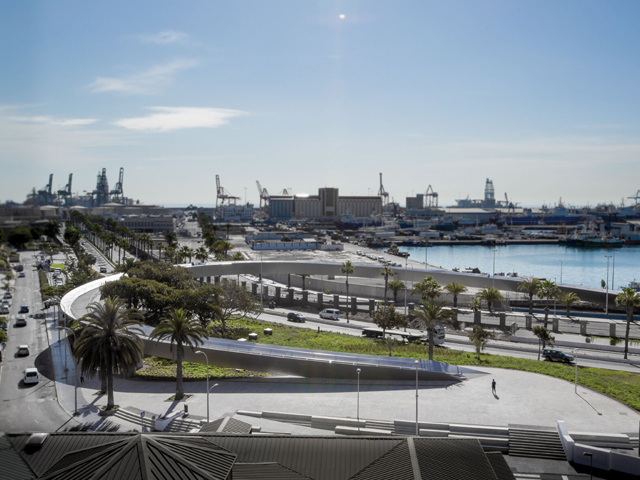
“The result is a highly innovative structural system, an extremely efficient triangular profile shape not common in the world of bridge engineering, capable of spanning the required curved distances with a great performative agenda and a minimalistic aesthetic,” claimed the architects.
A hyper-functional structure inspired by naval engineering designs, Onda Atlántica has a width of 3 meters and a maximum slope of 6 percent. The floor level of the bridge reaches a maximum height of 7.60 meters above street level, turning it into a new viewing point for city dwellers. Inspired by naval engineering designs, the architects developed a structural scheme that gave every component of this footbridge a structural function, except for the handrails — for which they adopted a system of ribs or frames arranged every 3.2 meters tied up by 10-12mm steel plates.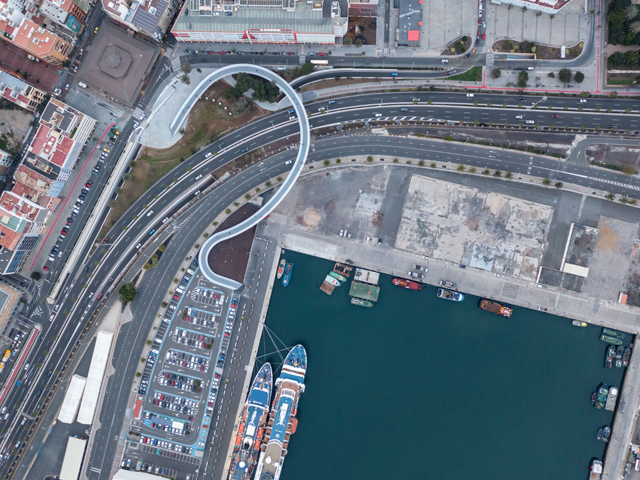
The 18 pieces that make up the final structure, weighing up to 40 tons apiece, were assembled at a metallurgical shop in Seville before being transported by ship to the site. The bridge was later coated in a three-layer paint with a metallic finish that helps it, depending on daylight, blend into the urban fabric and ensures protection against the highly corrosive maritime conditions.
In finalising the scheme, two public spaces have been redesigned to accommodate the footbridge landings. On one side, a fluid plaza receives all converging pedestrian traffic, designed with undulating green shapes that can be seen from above as a horizontal vegetal painting. On the other side, a non-walkable landscape reproduces a volcanic topography by reclaiming rocks from the neighbouring Isleta Mountain.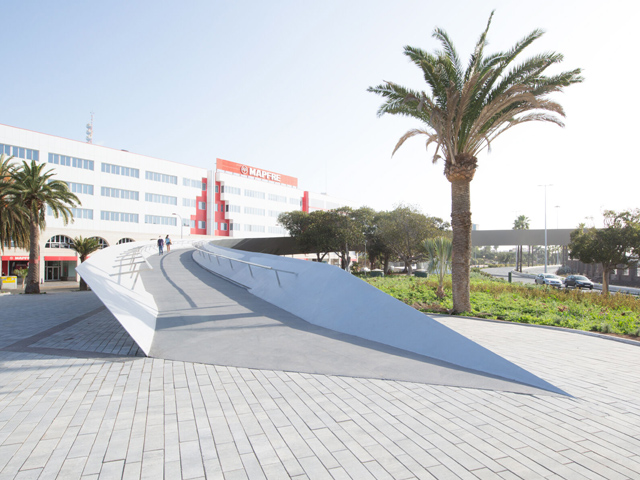
Images Iwan Baan & Javier Haddad via Archello