
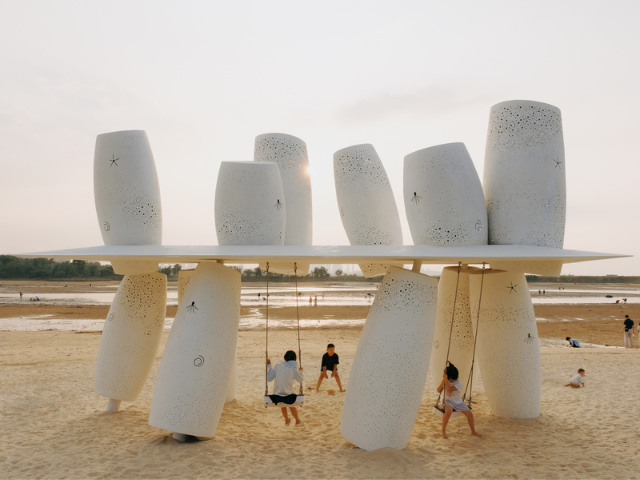
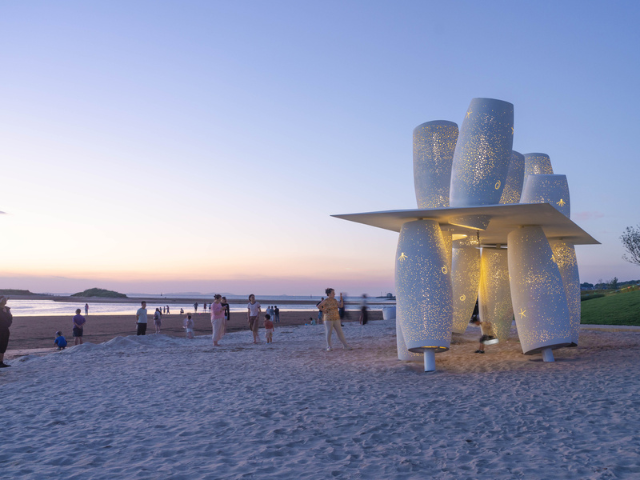
Text description provided. "Coral" is a swing art installation located at the northwest corner of West Park at Longfor Puti Coast in Yantai, China. Facing tidal flats and sea, the site is shaped by the daily rhythm of tides, sea breeze and sunsets, which together form its most distinctive landscape.
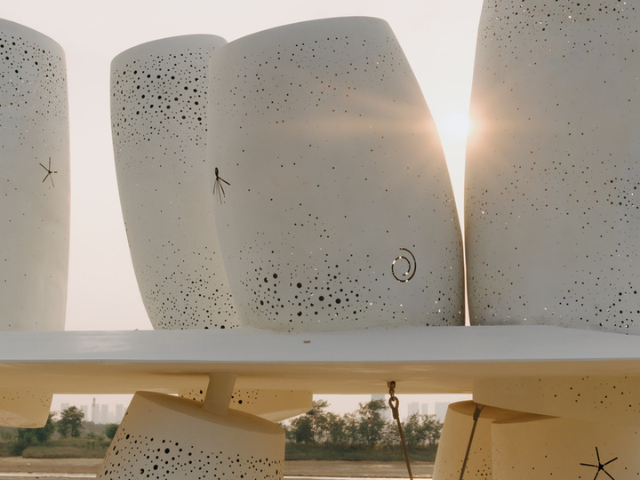
The form of the installation is inspired by the repetition and aggregation of similar units found in coral colonies. The design uses twelve white stainless-steel cylinders as basic units, arranged into two groups above and below. A thin horizontal roof plane passes through the composition, with two west-facing swings suspended beneath it. The cylinders, positioned at different heights and orientations, overlap and shift against one another, creating an inhabitable space for people to enter, move through and pause.
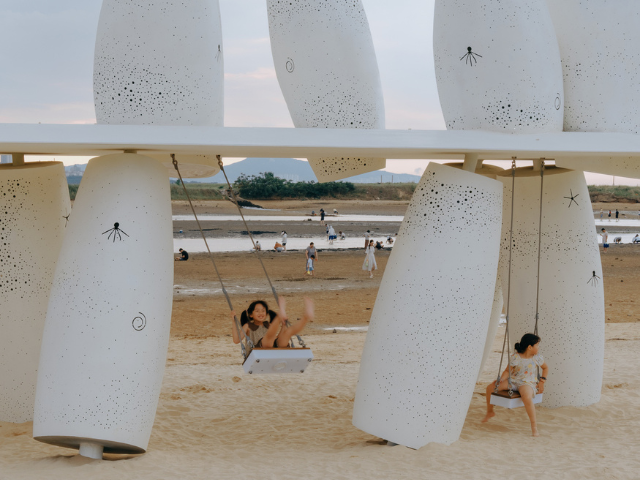
Viewed from a distance, the white forms emerge along the open coastline as an unfamiliar presence, resembling a group of marine organisms. As visitors approach, the spaces between the cylinders gradually reveal fragments of tidal flats, sea and sky, transforming the continuous landscape into a series of constantly changing frames.
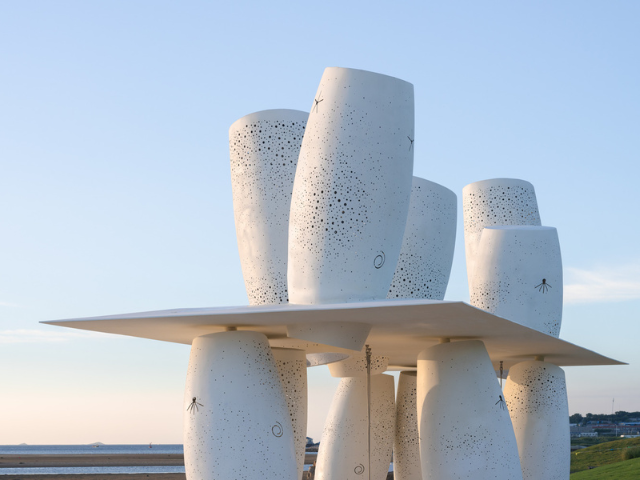
Upon entering the installation, the relationship between body and scale begins to shift. The oversized cylinders surround the body, making the familiar coastline temporarily feel unfamiliar, as if entering an underwater world. Visitors can move through the structure or sit on the west-facing swings, experiencing the sea breeze, tides and sunset through gentle movement.
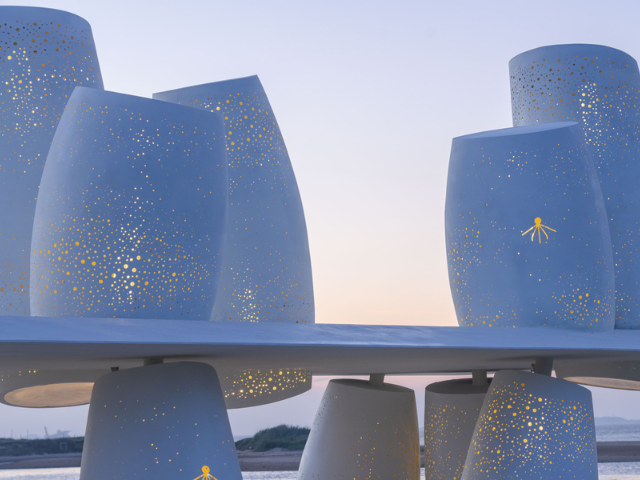
The perforated patterns on the cylinders are inspired by variations in the density of deep-sea fish schools. Each cylinder contains approximately 2,000 to 4,000 perforations of different sizes, ranging from 4 to 25 millimeters in diameter.Variations in the density and scale of the openings create a gradient texture on the white stainless-steel surfaces, evoking the gathering and dispersal of fish schools. Among these openings, a small number of larger perforations take the forms of marine creatures, including starfish, octopuses, and seashells, adding another layer of detail to the surface. After sunset, light emerges through the perforations, transforming the previously quiet white forms into another state. The installation gradually appears like a group of slowly breathing marine organisms.
Since its completion, Coral has become a gathering point along the coastline. Local residents and visitors often come here to watch the sunset, while children and adults discover different ways of interacting with the swings. After dark, the illuminated installation continues to attract people to stay and experience the changing atmosphere of the waterfront.
CORAL SEASIDE SWING
LOCATION West Park, Longfor Puti Coast, China
ARCHITECT XBTW Office
PHOTOGRAPHY Yumeng Zhu, DONG Image