BUILDING WITH ALGAE
04 Jun 2019
Algae building technology could be the next big thing in sustainable construction for Australia, according to a team of researchers from the University of Technology, Sydney. But will it work?

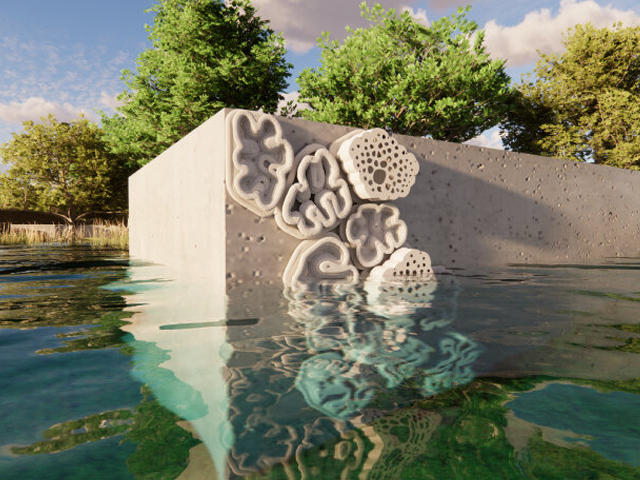
Artist’s impression | Paul Stoller, Atelier Ten Environmental Design Consultants
Article by Professor Sara J Wilkinson and Dr Marc Carmichael, University of Technology Sydney
The age of fossil fuels is drawing to an end, and some believe the 21st century will be the age of the biofuels. A team of UTS researchers are currently working on one promising option – algae building technology – with the hope that it will be the next big thing in green buildings.
It’s quite likely that algae building technology isn’t a term you are familiar with. I certainly had never heard of it until Professor Peter Ralph from UTS’s C3 research group and expert in microbiology showed me an Arup designed building in Hamburg, Germany, with algae façade panels called the BIQ building.
HOW IT WORKS
It turns out that solar thermal energy is produced in the façade panels, called photobioreactors (PBRs), where the algae grows in water. The solar thermal energy (heat) is extracted using heat exchangers and stored below ground in a central plant where it heats a separate supply of water for use within the building.
The biomass produced in the panels is harvested every three to four weeks to be converted to biofuel (either on or offsite, depending on the scale of the project), which provides energy for heating and cooling equipment and building services.
The biomass grown totals around 30KWh metre square per year.
The biofuel is used for hydronic heating in winter and hot water throughout the year to cater to the mild winters and mild summers typical of Hamburg’s marine west coast climate (northern hemisphere).
The water temperature of the panels is controlled by the speed of fluid flowing through them, with lower flow rates giving more time for sunlight to warm the water passing through.
Additionally, the amount of heat extracted via heat exchangers affects the PBR water temperature. The maximum temperature within the PBRs is kept around 40°C, because higher temperatures harm, or even kill, the microalgae.
Because the temperature of the panels needs to stay reasonably low, this limits the practical use of the extracted heat to mainly a pre-heating function for other building systems.
In a warmer climate such as Australia, this might vary.
CAN IT WORK IN AUSTRALIA?
Twelve months later after researching algae (and what an amazing organism it is – there are over 500,000 different species apparently) and interviewing 23 built environment professionals such as engineers, building surveyors, property managers, facility managers, contractors, sustainability managers, planners and valuers, we had a pretty comprehensive understanding of the drivers and challenges the technology might face.
We’d also learned algae can be used to bioremediate black and greywater, meaning it has the potential to clean water on site for reuse, flushing toilets and watering soft landscaping exists.
Combined with high thermal mass and passive house design technologies to further reduce operational energy consumption in cooling and heating, algae building technology could offer another way to mitigate built environment related greenhouse gas emissions. 
DRIVERS AND BARRIERS TO ALGAE BUILDING TECHNOLOGY
Environmental drivers include carbon abatement, bio-building technology and greater ratings in environmental tools such as BREEAM, Green Star or LEED.
As well as leading to lower operational GHG emissions, if adopted on a larger scale this technology could help mitigate the urban heat island effect. It could also reduce loading on existing energy infrastructure.
Another driver is the possibility to retail the biomass to pharmaceutical companies, where high-value algae species are used, or for potential food production, with potential sales revenue offsetting energy costs.
It could also gain innovation points in building-rating tools which then generate higher capital and rental values in some markets.
But with all new technologies, there is a risk that the innovation does not perform as predicted and this needs to be managed, as current renewables such as solar, PV and wind produce more energy than algae.
It’s worth pointing out that there was a time when solar energy cost over $2700 a watt in the 1950s and production levels were nowhere near as high as they are today.
Moreover, Australian algae production rates may be higher than Germany because there is more sunlight over longer periods of time. The BIQ building in Hamburg is even shut down due to lack of winter sunlight which would not be a problem in Australia, though overheating may be an issue.
Other downsides include fears about odours, contamination and leaks because some algae species contain hepatotoxins and neurotoxins, which are harmful to humans. Any damage could cause leakage and unpleasant smells.
Drivers and barriers to algae building technology
Drivers
- Innovation
- Carbon abatement
- Improved environmental performance
- Lower GHG emissions
- Lower running costs
- Heat transfer and shading
- Mitigation of Urban Heat Island
- Reduces load on energy infrastructure in urban settlements
- Retail opportunity of biomass
- Higher capital and rental value
Barriers
- Risks of poor or non-performance
- Other renewables produce more energy
- Costs of new technology
- Odours may occur if panels leak
- Human health risks with some algae
WHERE THE RESEARCH IS AT
Following the feasibility study into the drivers and barriers to using algae building technology in Australia, we secured further funding from the City of Sydney and partnered with Lendlease, GJames and Arup to design and test the algae prototype panels.
Two portable one metre squared panels will be set up on the rooftop of UTS’s Science building in the coming months, where their performance will be monitored over twelve months.
By understanding the inner workings of PBR cells, especially in the Australian environment, we hope to not only answer the question “will this work?”, but be able to optimise PBR design to increase the attainable benefits.
We hope, in time, to see that economies of scale and innovation do to this technology what it did to solar energy; for costs to plummet from over $2700 a watt to $1.14 in just over 50 years and for production rates to increase beyond all predictions.
Professor Sara J Wilkinson is professor of property at UTS and is a chartered building surveyor. She works at the intersections of sustainability, urban development and transformation. Dr Marc Carmichael is a lecturer at the UTS School for Mechanical and Mechatronic Engineering and a member of the Centre for Autonomous Systems.
Via Fifth Estate