

With its record-breaking number of visitors, Expo 67 it was the most successful world’s fair of the 20th century and fueled a construction boom in the city that stretched into the late 1970s.
The original site on Île-Sainte-Hélène, across from the city’s famed Old Port, became emblematic of Montreal’s growth as a budding metropolis. A changing political environment in the 1980s and ‘90s, driven by nationalist Parti Québécois governments, meant that the once-iconic site was left largely abandoned before being turned into a wooded park. Many of the fair’s original structures didn’t survive the passing of time, save a very large Buckminster Fuller–designed geodesic dome—now known as the Biosphere—and Alexander Calder’s monumental Trois disques sculpture, as well as Moshe Safdie’s Habitat 67 housing project on a nearby site.

For Montreal’s 375th anniversary celebrations, the City of Montreal commissioned a series of urban regeneration projects aimed at addressing decades of underfunding. Part of this scheme included overhauling Parc Jean-Drapeau, the site’s official name—the City tapped local firm Lemay to helm the renovation. Because of the ‘67 connection, the restoration became emblematic of Montreal’s ideological aim to project itself as a global city rather than a regional capital.
The main feature of the redeveloped park is a new central concourse that links the Biosphere and Calder’s sculpture on the banks of the Saint Lawrence river, creating a cohesive path for visitors through the park. The project also restored a 65,000-capacity amphitheater and riverside walkway. Mindful of the site’s legacy, all new interventions echo the simple geometric vocabulary of Expo 67.
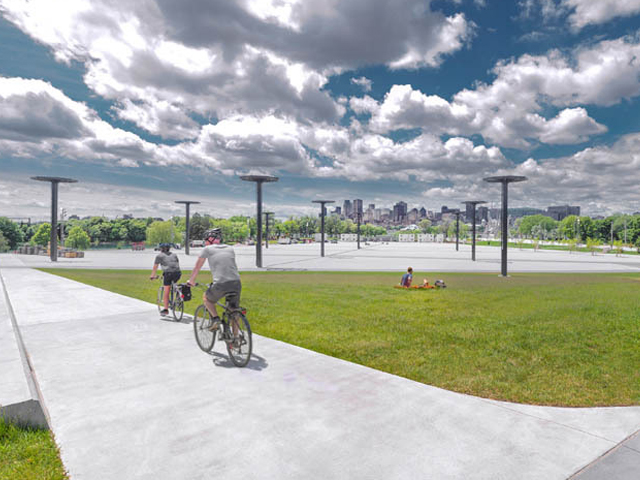
“This intervention was really about the links from the Bucky dome to the Calder sculpture and really clarifying the visitor experience,” said Andrew King, partner and design principle at Lemay. “This is about linking the waterpark, the newer landscape, and the native landscape elements; creating a series of events, a topographic sequence, and more of a meander through the site.”
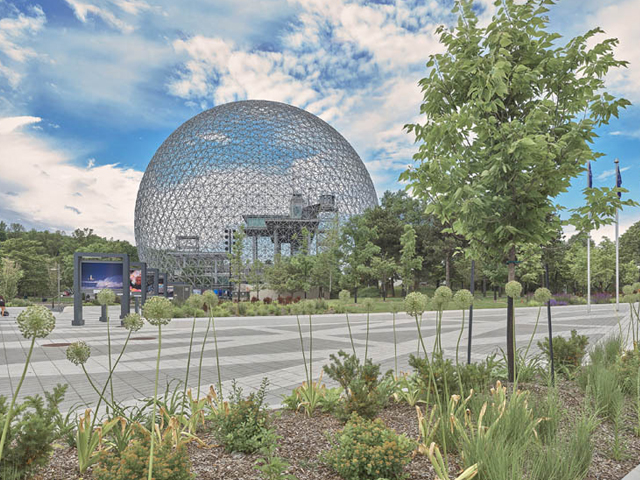
Images Marc Cramer & Jean-Drapeau via Archdaily