SELF-SUFFICIENT CITY FOR POST-COVID LIVING
20 Aug 2020
Guallart Architects has revealed its competition-winning entry for the design of a self-sufficient city in Xiong'an, China, that will promote post-COVID-19 living. The project defines a new standard of urban living by combining European and Chinese architectural practices with sustainable urban farming.
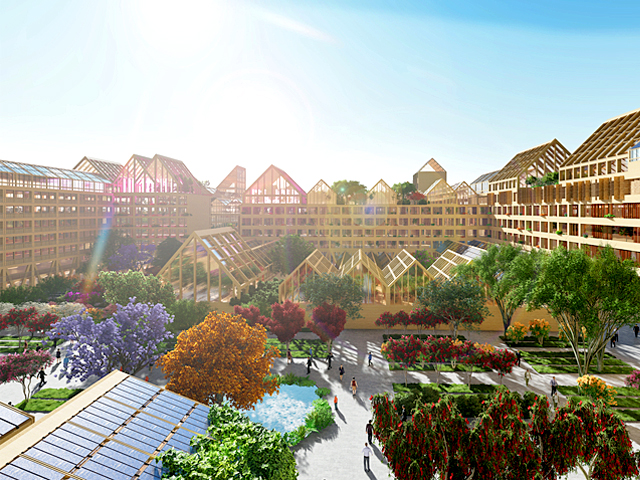
Barcelona-based Guallart Architects seeks to define a new standard of urban living, one that can be applied as a raw model in different cities around the world. "We cannot continue designing cities and buildings as if nothing had happened," says Vicente Guallart, founder of Guallart Architects, of the COVID-19 crisis.
Entitled the Self-Sufficient City, the timber project introduces a new type of urban model: a hybridisation of traditional urban blocks of Europe, the contemporary towers of china and the productive farming landscape. This new urban environment offers a single place in which occupants can live, work and rest, and produce resources locally while remaining connected globally. This model ensures a full life even in prolonged periods of confinement. 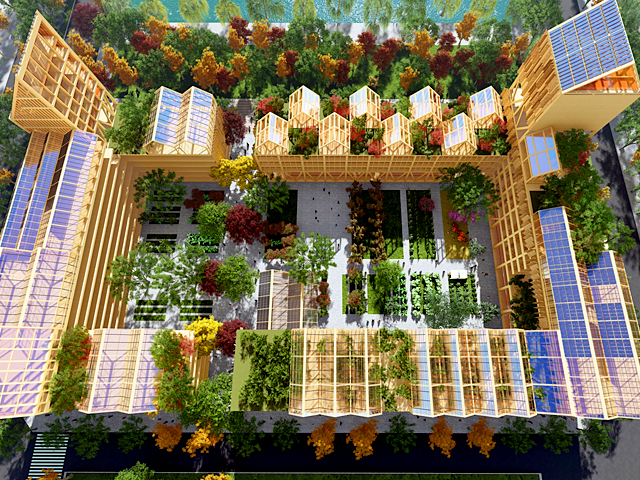
Guallart Architects conceives the city as an accumulation of layers, defining a range of functional needs for human life at different scales, from the home, to the building, to the community. Organised in four blocks, the structure will be built of mass timber with passive design solutions. A mix-use program includes apartments, residences for all generations, offices, swimming pool, shops, food market, kindergarten, an administrative centre and a fire station.
Each building will be covered by greenhouses that will allow for the daily harvest of produce, enclosed beneath sloping roofs which collect solar energy. 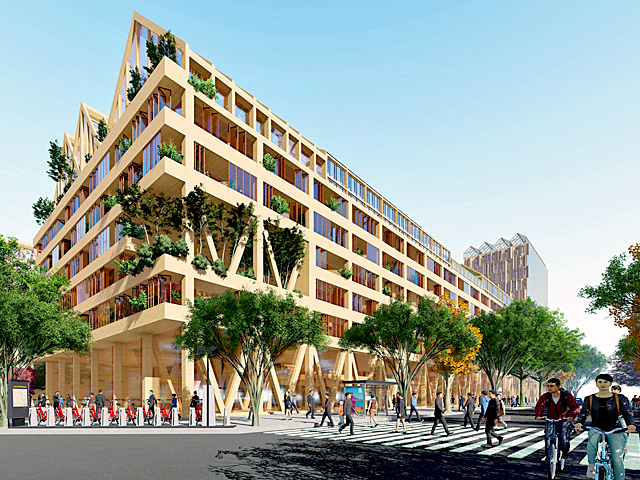
All apartments will feature a large south-facing terrace, serving as the primary space of leisure during long periods of confinement. Likewise, the units will offer ‘telework’ spaces, creating social networks at neighbourhood-scale for the exchange of resources.
Along the ground floor, small coworking digital factories will offer occupants a lab of 3D printers and rapid prototyping machines to design and fabricate small objects for daily use. 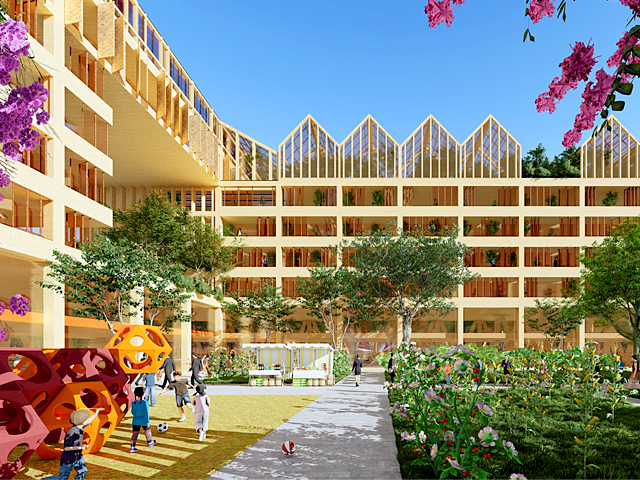
The project will comprise an internal metabolic system, integrating energy and food production, recycled water, and material reuse to promote a distributed model for urban management.
“We developed this project during confinement, when the entire team worked from home, explains Honorata Grzesikowska, director of the office, “and we decided to include all those aspects that could make our lives better, so that a new standard could be defined.” 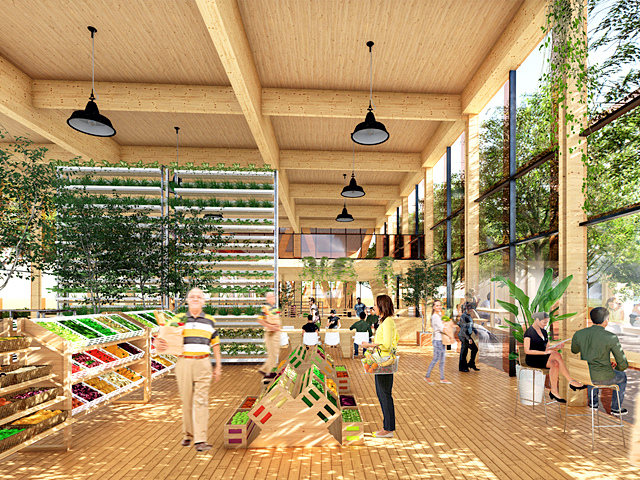
Images © Guallart Architects


MORE NEWS
MELBOURNE'S NEW PARK ON A FORMER LANDFILL SITE
WOOD CARVING WITH BRANDON KROON
STRIKING GOLD IN BALLARAT
JARRAHDALE TRAIL CENTRE TAKES DESIGN CUES FROM NATIVE FLORA

MASTERPLAN FOR INCLUSIVE, CLIMATE-RESILIENT COMMUNITY PARK IN LISMORE
