BRINGING COLOUR TO THE GREY
08 Apr 2026
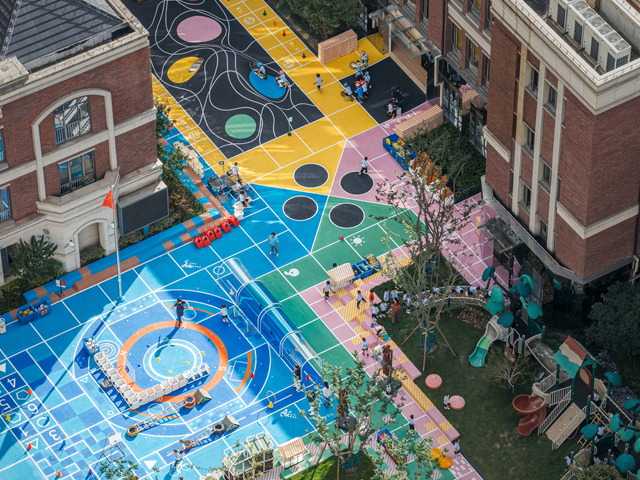
This second-level community park, built on the roof of a small theatre, demonstrates the impact of innovation and colour in outdoor public spaces. Brightly coloured amenities from ping-pong tables to seats contrast the pastel designs of the rooftop surface, turning an unused grey platform into a youth haven.
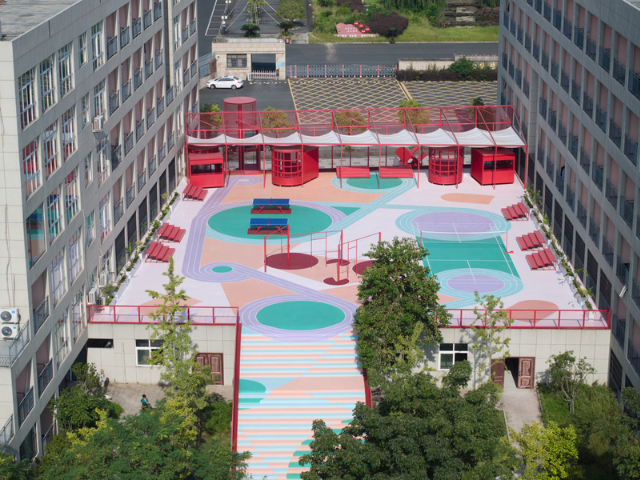
Text description provided by the architects. Never designed as a theater, yet through everyday gathering it ceaselessly stages its own impromptu drama—a forgotten rooftop in a small Chinese county becomes a community commons where minimum material yields maximum public life. In the Shuinan Sub-district of Songyang County, Zhejiang Province, a second-floor platform sits enclosed by multiple residential buildings. Built between 2015 and 2017, the community failed to operate effectively for years; the platform had long been left unused—its surface cracked, facilities absent, a rudimentary public restroom fallen into disrepair. Despite its central location, the lack of physical accessibility and clear programmatic logic left the space largely ignored.
In 2024 the community was converted into subsidized youth housing. A growing number of young residents moved in, bringing demands for daily exercise, social interaction, and communal activities that existing spaces could no longer accommodate. Studio RE+N was invited with an open-ended question: what could be done to improve the overall living quality of the neighborhood? Given constraints of land ownership, zoning designation, and budget, the architects identified this neglected platform as the site with the greatest public potential, proposing an intervention guided by three principles—low cost, light structure, and high adaptability.
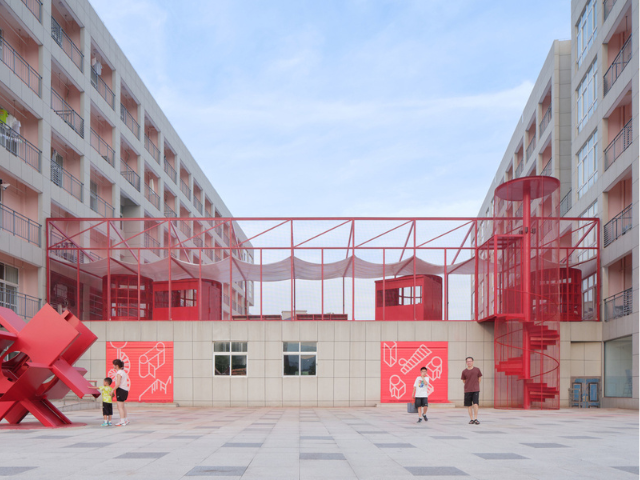
On the platform's west side, a series of red light-steel structures establishes a new street interface: a permeable linear canopy frame clad in metal mesh, a spiral stair tower bridging the level difference between street and platform, and canvas panels hung from the canopy that modulate light and shadow while forming a microclimate balancing shelter with openness. The formerly inward-facing platform is thus transformed into a double-sided open interface between street and community.
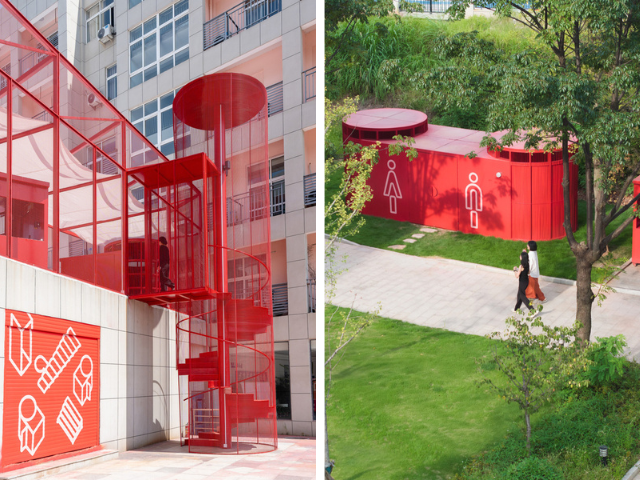
Beneath the canopy, movable service modules—enclosed by vertically arrayed rebar forming permeable screens—contain foldable tables, seating, storage shelves, and pegboard walls for future programming. Movable stepped seating provides conditions for impromptu performances and community gatherings. All modules are prefabricated for rapid on-site assembly, with flexibility for future adjustment and replacement.
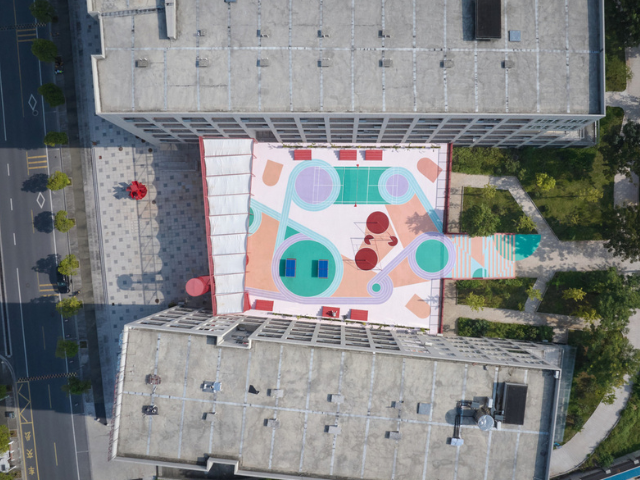
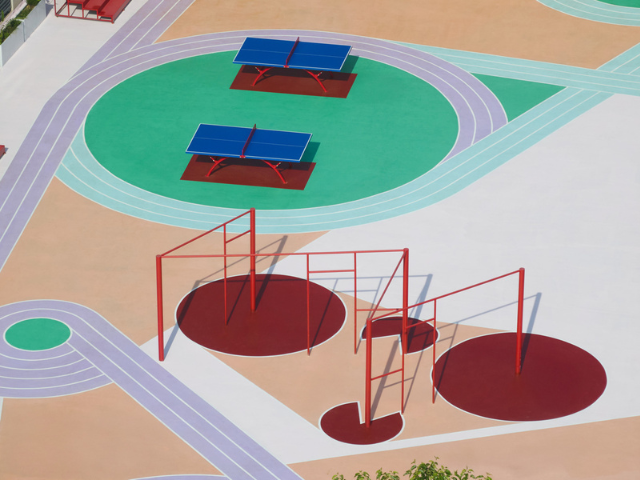
On the platform surface, a paving system combining radial and concentric patterns in pink, blue, and green—executed in weather-resistant SPU flooring—guides pedestrian flow and defines zones for table tennis, badminton, fitness, and a running track, all without hard barriers. The patterns extend to stepped seating on the east side, connecting public spaces along the east-west axis. Along the street edge, an interactive lighting installation using interlocking assembly logic serves as a landmark for the community. As night falls, LED strips embedded in structural joints transform the daytime skeletal frame into a soft, glowing presence, redefining the site's edges as approachable community boundaries.
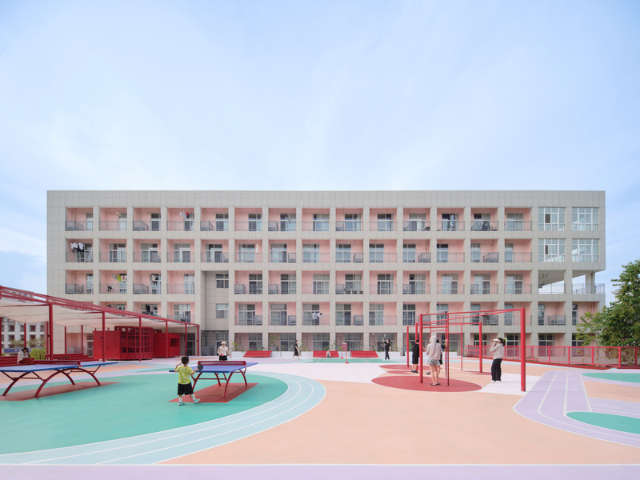
During the operational phase, the government and operators introduce monthly themed programs—music performances, neighborhood markets, and public forums. Residents practice dance, exercise, and hold evening gatherings. When the evening lights come on and people gather beneath the spiral tower, when others run and play across the colored ground, this once-forgotten rooftop re-enters the everyday life of the town—proof that in China's county-level context, public space need not be the outcome of predetermined functions, but a system that emerges and evolves through use.
LOCATION Lishui, China
ARCHITECT Studio RE+N
PHOTOGRAPHY Kejia Mei