
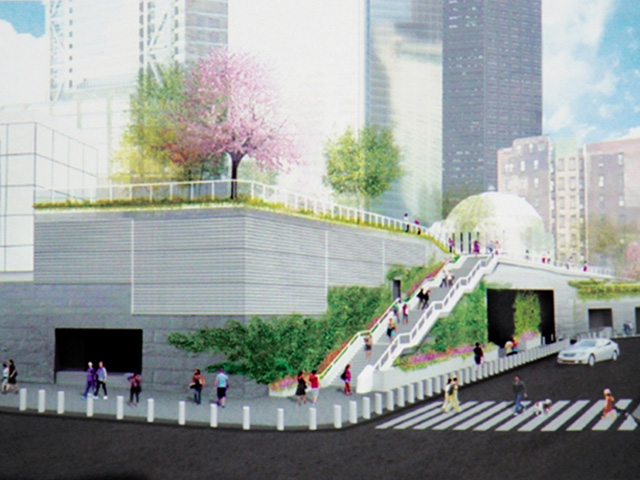
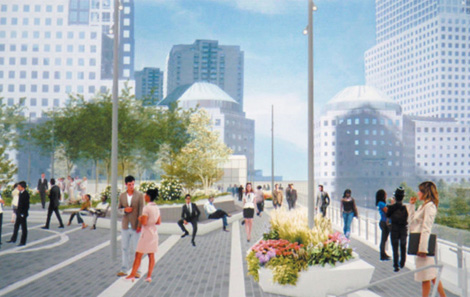
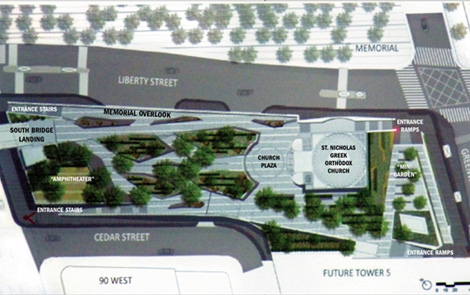
New renderings for Liberty Park reveal that the elevated park will be lined with planters, trees, benches, and light poles that overlook the 9/11 Memorial, and from the street level, pedestrians will also be able to appreciate a 300-foot living wall.The park will be constructed on the roof of the World Trade Centre’s Vehicle Security Centre and will be accessible from Liberty, Cedar, West and Greenwich Streets.
Entrance ramps on the east side and stairs rising along the sides of the park platform will take visitors 20 feet above street level. From this elevated walkway, pedestrians can look out from the northern side and see panoramic views of the September 11 Memorial.
On top of bringing some much-needed colour to the cityscape, the park, designed by landscape architect Joseph E. Brown, will provide a crossing between the Financial District and Battery Park City. There will be seating for up to 750 people with much of it edging a perimeter around the planting beds. Further down on the western side is a large seating area that the Port Authority is currently calling an amphitheatre. The park will also be home to the new Santiago Calatrava-designed St. Nicholas Greek Orthodox Church after the original building was destroyed during the 9/11 attacks.
The park’s floral additions include a mini-garden of trees and seating on the park’s eastern end. Meanwhile, Dogwoods and other ornamental trees standing 18- to 35-feet tall will adorn the walkway. From street level, the park’s most striking feature is a 300-foot living wall spread across the building’s northern side on Liberty Street. This garden wall will be made up of a variety of plant species including periwinkle, winter creeper, baltic ivy and other plants.
The city expects the project to be completed in 2015.