THE MOST SUITABLE TREES FOR HEDGING
24 Feb 2026
When it comes to hedging, there are 4 key things to consider. To match tree with need, this broad selection question requires extra background information only answered with another series of questions in return. These considerations from Speciality Trees are here to guide you in making the best choice for your hedging project.
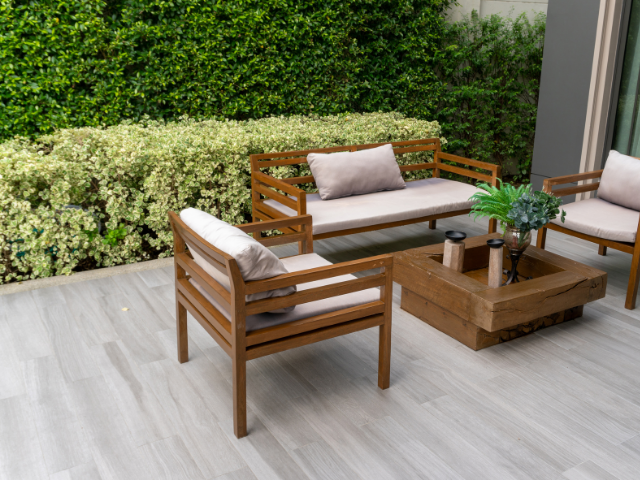
HOW BIG IS THE PLANTING SPACE?
This is where the conversation needs to start as planting something that grows too big and/or too wide for the garden space can be problematic in the long run. Does the new hedge suit a particular purpose such as to frame a fence line, footpath or driveway or will it be required to block out a structure? Understanding the requirements for the hedge you’re planting is definitely the first step.
WHAT IS THE PLANTING CLIMATE AND ASPECT?
Urban situations create unique micro-climates which fuse these two elements together. Essentially it is important to know how much light and sun the position gets on a daily basis and how cold temperatures get in winter.
Using winter as the base for assessing light, for areas receiving over 2 and under 5 hours a day (considered part-shade) selections would best suit Waterhousea floribunda ‘Whisper’ or Acmena simthii ‘Sublime’ TM PBR as they will tolerate low light and dappled shade. Hedging in full shade is not really an option with traditional hedging lines.
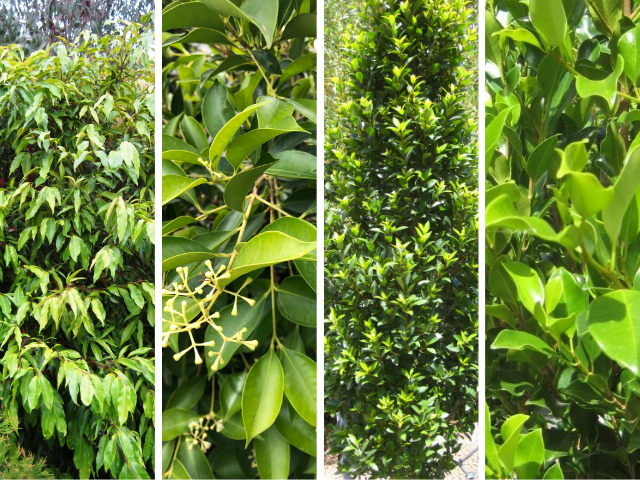
Native hedging options (from left to right): Whaterhousea floribunda ‘Whisper’, Acmena smithii ‘Sublime’, Syzygium australe ‘Hinterland Gold’ & Ficus hillii ‘Flash’
Almost all traditional selections will need full sun, typically 6-8 hours a day to promote foliage density, but the amount of water needed will vary between species. For drier climates reliant solely on rain – think country shelterbelts as well as non-irrigated positions around homes - you could consider the super hardy Photinia robusta, Prunus lusitanica (Portuguese laurel) or Thuja plicata (Western Red Cedar).
When it comes to frost, be aware of what your hedge can tolerate particularly if you live in a colder part of Victoria. Syzygium and Ficus selections don’t cope well with frost and anything around zero or lower will result in some burning on new foliage. While these temperatures won’t kill the tree, a severe -4°C to -5°C frost could end the life of a young tree in its first winter. Again, natives Acmena and Waterhousea will tolerate the colder months better but there are evergreen exotic alternatives to consider here too such as Laurus nobilis (Bay Tree), Prunus lusitanica (Portuguese Laurel), Photinia robusta and Juniperus chinensis ‘Spartan’.
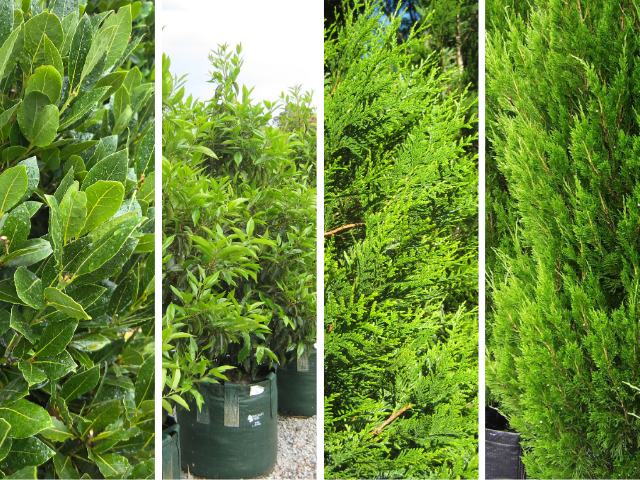
Exotic selections for hedging (from left to right): Laurus nobilis ‘Miles Choice’, Tristaniopsis laurna Luscious PBR TM, Thuja plicata fastigiate & Juniperus chinensis ‘Spartan’.
LEAF AND FLOWER-RELATED LITTER
Evergreen trees, like all trees that are living, shed leaves. It is part of a healthy growing cycle and at times a mechanism that allows them to deal with adversity or stress. This is not dissimilar to humans. The flower on some hedging selections can be a little messy at certain months of the year so know your tolerance to this. While some unseasonal mess cannot be avoided, a timely clip to keep the hedge tidy removing berries and fruit before they drop or blossom will minimise it greatly.
As tree people, we view flowers and fruit as adding character to a hedge or screen and aesthetics to a landscape, however in a narrow bed or courtyard setting where mess can be an issue, it is advised to choose wisely.
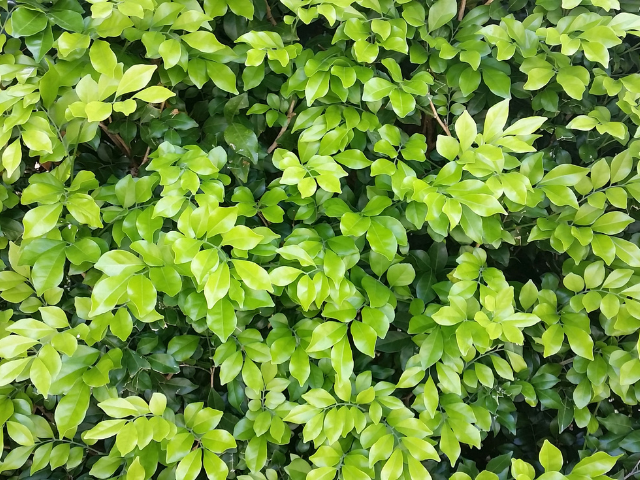
Lilly Pilly
In the case of Lilly Pilly, Acmena and Waterhousea traditionally flower less than Syzygium as their berries tend to be smaller and paler in colour. Syzygium berries are larger and are pink to dark purple in colour making both a beautiful feature or a large mess depending on your viewpoint. Ficus hillii ‘Flash’ and Lauris nobilis ‘Miles choice’ provide a cleaner option, and while they can still flower and fruit, both are significantly smaller and will leave little to no mess if well clipped.
UNDERSTANDING THAT A TIGHT HEDGE REQUIRES TIME AND EFFORT
A great selling point for Waterhousea ‘Whisper’ is that one hard prune a year will leave the hedge looking fresh and lush for a full 12 months. It’s form and pendulous foliage is still beautiful if left to grow out a little.
If the preference is for a tightly clipped hedge, a gentle prune is recommended every 6-8 weeks from summer to late autumn to encourage foliage density. Choose tighter-growing selections such as Syzygium ‘Hinterland Gold’, Syzygium ‘Straight and Narrow’ TM PBR, Acmena ‘Sublime’ TM PBR, Ficus ‘Flash’ or Prunus lusitanica for this form, as they respond best to pruning.
Head to this article for further insights on hedging or visit Speciality Trees via the links below.



MORE NEWS

SQUEEZE ME IN: SCREENING TREES FOR NARROW SPACES
FLEMING’S APPLAUDS STATE GOVERNMENTS TREE INITIATIVES

OZBREED'S GROUND HUG™ HAS WON SPECIALIST PLANT OF THE YEAR 2025!

OZBREED'S NEWEST PLANTS

HOW EARTHLIFE PRODUCTS HELP LANDSCAPERS AND BUSINESSES OVERCOME COMMON CHALLENGES
